
Giant triton shell
트리톤 소라(나팔고둥)
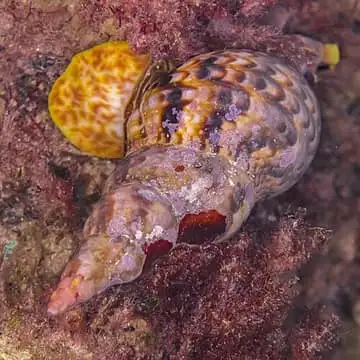
A giant coral-reef sea snail with a shell up to about 60 cm long. It eats crown-of-thorns starfish, which devour coral, so it helps protect reefs. Its shell has long been blown like a trumpet.
See it on the 3D globe →At a glance
- Class
- Molluscs
- Diet
- Meat eater (carnivore)
- Habitat
- coral reefs
Quick answers
Where does the Giant triton shell live?
It lives in coral reefs of the Indian and Pacific oceans.
What does the Giant triton shell eat?
Its diet: meat eater (carnivore).
The giant triton, also called Triton's trumpet, is a very large sea snail of Indo-Pacific coral reefs. Its pointed, spiral shell can be around 40 to 60 centimetres long, so it is one of the biggest mollusks living on a reef. It is found from the Red Sea across the Indian and Pacific oceans. Its shell is usually whitish with brown or yellow markings.
It is famous for eating the crown-of-thorns starfish, a spiny starfish that devours coral. It is one of the few animals that eats it, tearing it apart with a rough, file-like tongue called a radula. For this reason the triton is seen as a helper of coral reefs. Its beautiful shell is also traditionally used as a trumpet.
Shell trumpets
People in many cultures have drilled the shell tip and blown it like a horn. In Japan it is called horagai, in the Maldives sangu, in Hawaii pu, and the Maori call it putatara. Shells are also sold as decorations in shell shops, which is one reason the species needs care.
Friend of the reef?
Crown-of-thorns starfish sometimes multiply into plagues that kill large patches of coral on places like the Great Barrier Reef. Some scientists have wondered whether overfishing of tritons helps those outbreaks. In 1994 Australia proposed protecting the triton under CITES, but the proposal was withdrawn because of limited trade data. It is protected in some countries but can be legally traded elsewhere.
A snail that hunts starfish
Giant tritons are active hunters, not slow grazers. They feed on other molluscs and on starfish, and they can follow the scent of prey, turning to chase it. Crown-of-thorns starfish can be up to a metre across and covered in venomous spikes, and some seem to sense a triton coming and try to flee. But the snail is faster. It grips its prey with its muscular foot, and a starfish can escape only by giving up the arm the snail seizes first. Triton snails have separate males and females. The female lays white egg capsules, and the larvae drift in the plankton for up to three months.
Fun facts
- It is one of the few predators of the coral-eating crown-of-thorns starfish.
- It is one of the few animals that eat crown-of-thorns starfish.
- Its shell has been used as a trumpet for centuries.
- In Hawaii the shell trumpet is called pu.
- It is one of the largest mollusks on a coral reef.
On the globe
On the toy globe the triton crawls over a coral reef in the Indo-Pacific. Look for the spiral shell.
More like this
,_Cynthiana,_Pafos,_Chipre,_2021-12-11,_DD_14.jpg)
Sources
- Read more on Wikipedia
- Charonia tritonis — Wikipedia (English)
- Charonia — Wikipedia (English)
- Crown-of-thorns starfish — Wikipedia (English)
Updated: 2026-10-14