
Flamboyant cuttlefish
화려한 갑오징어
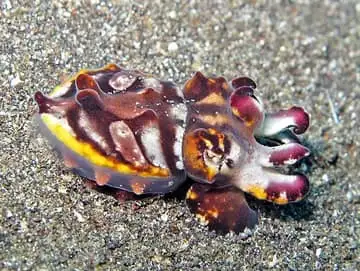
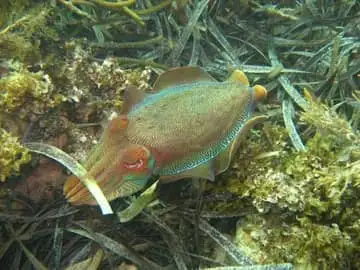
A small cuttlefish only about 8 cm long that often walks along the seafloor on its arms instead of swimming. Its body flashes purple, yellow and white. It is one of the few cephalopods known to have toxic flesh, and it lives only about a year.
See it on the 3D globe →At a glance
- Class
- Molluscs
- Diet
- Meat eater (carnivore)
- Habitat
- coral reefs, coasts
Quick answers
Where does the Flamboyant cuttlefish live?
It lives in coral reefs, coasts of the Indian and Pacific oceans.
What does the Flamboyant cuttlefish eat?
Its diet: meat eater (carnivore).
The flamboyant cuttlefish, Ascarosepion pfefferi, is a small cuttlefish of tropical Indo-Pacific waters. It lives off northern Australia, southern New Guinea, and many islands of the Philippines, Indonesia and Malaysia. Most sources say it grows to about 8 cm in mantle length, though a few give 6 cm.
Its body is broad and oval, and its arms are wide and blade-like. When it is calm it is dark brown, but if it is disturbed it flashes black, brown and white with yellow patches, and its arm tips can turn bright red. Divers love it because it often strolls across sand and mud on its lower arms instead of swimming. In 2023 it was moved from the genus Metasepia into the genus Ascarosepion.
Walking and flashing
Most cuttlefish swim, but this one is a walker. Its cuttlebone, the light inner shell, is small, so it can float only for a short time. It lives on sand and mud at depths of roughly 3 to 86 metres and hunts fish and crustaceans in the daytime.
While it ambles along, it waves the wide flaps on its arms in a steady rhythm. Scientists think the show warns predators that its flesh is poisonous.
Is it really toxic?
A toxicology report found that its muscle is highly toxic, and one researcher linked the poison to the same one used by the blue-ringed octopus. Later tests by other researchers found only tiny traces of that toxin, too low to harm vertebrates. So the warning colours are real, but the exact chemistry is still being sorted out.
Because of this, fishing fleets show no interest in it.
Eggs and hatchlings
Mating happens face to face. The female lays eggs one at a time and tucks them into cracks in coral, rock or wood. In one case about a dozen eggs were found under half a coconut husk, pushed in through its central hole, where fish could not reach them.
Fresh eggs are white and slowly turn clear, so the baby inside can be seen. Hatchlings can already make the adult colour patterns and get no care from their parents. Where it lives: the first one ever collected came from the Arafura Sea in 1874.
Fun facts
- Rather than swimming much, it "walks" along the seabed while flashing waves of colour.
- The first specimen was collected on 9 October 1874 during the Challenger expedition.
- It is one of the very few cephalopods thought to have poisonous flesh.
- Eggs have been found hidden inside a coconut husk.
- Its sand-walking is possible because its cuttlebone lacks the outer cone most cuttlefish have.
On the globe
The cuttlefish crawls along the seabed in the Indo-Pacific. Look for the broad body and bright colours.
More like this
.jpg)
Sources
Updated: 2026-10-14