
Giant clam
대왕조개
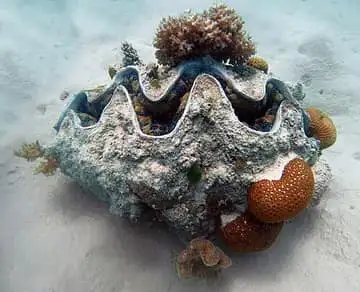
The giant clam is the biggest clam on Earth, with a shell over 1 m long and weighing up to about 200 kg. Its bright mantle colours come from algae living inside, which feed it using sunlight. It can live for more than 100 years.
See it on the 3D globe →At a glance
- Class
- Molluscs
- Diet
- Filter feeder
- Weight
- about 200 kg
- Length
- about 1.2 m
- Lifespan
- up to about 100 years
- Conservation status
- Critically Endangered (IUCN CR)
- Habitat
- coral reefs
Quick answers
Where does the Giant clam live?
It lives in coral reefs of the Pacific and Indian oceans.
How big is the Giant clam?
It grows to about 1.2 m and 200 kg.
What does the Giant clam eat?
Its diet: filter feeder.
How long does the Giant clam live?
It can live up to about 100 years.
Is the Giant clam endangered?
It is listed as Critically Endangered (IUCN CR).
The giant clam, Tridacna gigas, is the largest living bivalve, which means a mollusc with two shells like a mussel. It can weigh more than 200 kilograms, measure up to 120 centimetres across and live more than 100 years in the wild. It lives on shallow coral reefs of the South Pacific and Indian oceans, as well as near the Philippines and in the South China Sea.
It sits on flat coral sand or broken coral, at depths down to about 20 metres. Its bright mantle, the soft tissue that shows when the shell opens, is full of tiny algae. By day the clam opens its shell so the algae get sunlight, and in return the algae make most of its food. The animal has become extinct in many places where it was once common.
How does the clam feed?
Young clams drift as plankton, but adults stay fixed in place. They get most of their nutrition from zooxanthellae, one-celled algae that live inside the mantle and photosynthesise. Scientists are studying this method of farming algae as a model for efficient bioreactors. The mantle edge is covered with hundreds to thousands of tiny eyespots, each about 0.5 millimetres wide, and they sense changes in light. The clam can partly close its shell when the light dims.
What makes Tridacna gigas special?
Several other giant clams look similar, and many are mistaken for T. gigas. An adult T. gigas is the only one that cannot completely close its shell, so some of its brownish-yellow mantle always shows. Its shell has four or five vertical folds, while the similar T. derasa has six or seven. The Venetian explorer Antonio Pigafetta wrote about these clams in 1521, and people in East Asia have known them for thousands of years.
Fun facts
- Algae living in its colourful mantle make food from sunlight and share it with the clam.
- Its mantle has up to thousands of tiny eyes.
- An adult cannot close its shell all the way.
- The first known written description comes from 1521.
On the globe
The toy model of the giant clam sits on a coral reef. Look for the wavy shell and the colourful mantle.
Quiz time
Which is heavier: Giant clam or Giant Pacific octopus?
Show the answer
Giant clam. (200 kg vs 15 kg) Giant Pacific octopus →
More like this
_Michaelmas_Cay.jpg)
Sources
Updated: 2026-10-14