
Magellanic penguin
마젤란펭귄
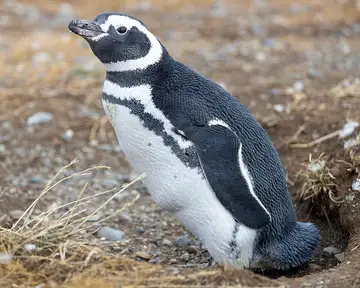
A South American penguin with two black bands across its chest. It nests in burrows dug into the ground and forms large colonies along the Patagonian coast.
See it on the 3D globe →At a glance
- Class
- Birds
- Lives in
- Patagonian coast, Argentina
- Diet
- Fish eater
- Weight
- about 4.6 kg
- Length
- about 0.7 m
- Lifespan
- up to about 30 years
- Conservation status
- Least Concern (IUCN LC)
- Habitat
- coasts
Quick answers
Where does the Magellanic penguin live?
It lives in coasts of the Atlantic and Pacific oceans. On the globe you can find it near Patagonian coast, Argentina.
How big is the Magellanic penguin?
It grows to about 0.7 m and 4.6 kg.
What does the Magellanic penguin eat?
Its diet: fish eater.
How long does the Magellanic penguin live?
It can live up to about 30 years.
Is the Magellanic penguin endangered?
It is listed as Least Concern (IUCN LC).
The Magellanic penguin, Spheniscus magellanicus, is a South American penguin that breeds along the coast of Patagonia, in Argentina, Chile and the Falkland Islands. Some migrate north to Brazil and Uruguay, and lost birds have turned up as far away as Australia and New Zealand. It is the most numerous of the banded penguins in the genus Spheniscus. It was named after the Portuguese explorer Ferdinand Magellan, who saw the birds in 1520.
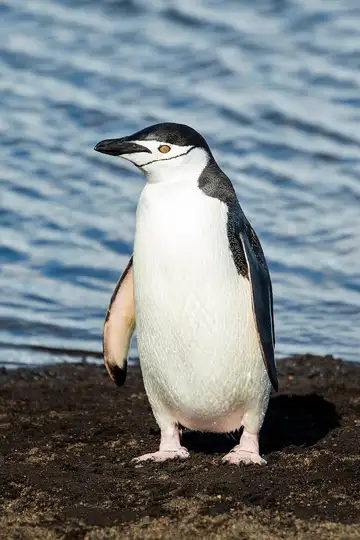
It stands 61 to 76 centimetres tall and weighs 2.7 to 6.5 kilograms. Adults have a black back, a white belly, and two black bands between the head and breast, the lower one shaped like an upside-down horseshoe. The IUCN lists it as Least Concern, though the population is decreasing. A wild bird can live up to about 25 years.
Fishing and diving
Magellanic penguins hunt in groups. They eat small fish such as Argentine anchoita and silversides, plus cuttlefish, squid, krill and squat lobsters. Jellyfish turn out to be sought out on purpose, not swallowed by accident. Adults regularly dive 20 to 50 metres, using their stiff wings like flippers, and a gland removes the salt they swallow with seawater.
A wide continental shelf in the Atlantic lets them forage far from the colony, and food is more reliable than for the Galapagos penguin.
Colonies and chicks
Breeding season starts in September, when adults reach big colonies on the coasts of Argentina, southern Chile and the Falklands, and it lasts into February and March. One of the largest colonies is at Punta Tombo. Nests, about 20 per 100 square metres, are under bushes or in burrows.
Two eggs are laid and incubated for 39 to 42 days in shifts of 10 to 15 days. Both parents care for the chicks, feeding them every two to three days. A successful bird raises on average about 0.7 chicks a season. Young birds have grey-blue backs and blotched feet, which turn all black at around ten years old.
Dangers
Oil spills kill about 20,000 adult and 22,000 young penguins every year off Argentina, and ships dumping oil at sea add to the problem, especially in the Strait of Magellan. Pumas are the main predator on land, and sea lions, giant petrels and leopard seals take chicks.
Climate change has pushed fish farther away, so some penguins swim 40 km farther, while their mates wait on the nest. A colony tracked by Dee Boersma fell by more than 20 percent over 22 years to 200,000 breeding pairs. More heavy rainstorms also kill chicks, which do not yet have waterproof feathers.
Fun facts
- It is named after Ferdinand Magellan, who spotted the birds in 1520.
- Jellyfish are a food they hunt on purpose.
- Chicks without waterproof feathers can die of cold in heavy storms.
- A Magellanic penguin named Captain Eo lived to age 40 at the San Francisco Zoo, dying in 2022.
On the globe
The model shows a Magellanic penguin with two black chest bands on the Patagonian coast.
Quiz time
Which is heavier: Magellanic penguin or Greater rhea?
Show the answer
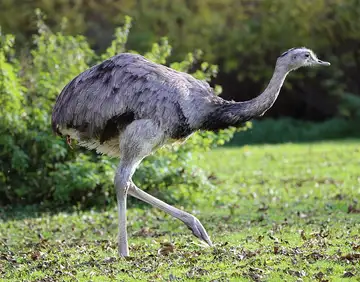
Greater rhea. (4.6 kg vs 25 kg) Greater rhea →
More like this


Sources
Updated: 2026-10-14