
Humboldt penguin
훔볼트펭귄
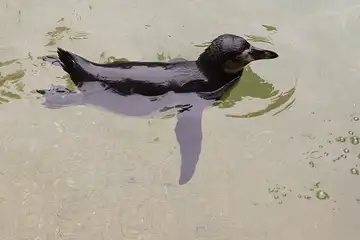
A penguin of the cold Humboldt Current coasts of Chile and Peru. It has a single black chest band and pink bare skin around the bill. In its warm climate, the pink skin helps it shed heat.
See it on the 3D globe →At a glance
- Class
- Birds
- Lives in
- Pacific coasts of Chile and Peru
- Diet
- Fish eater
- Weight
- about 4.5 kg
- Conservation status
- Vulnerable (IUCN VU)
- Habitat
- coasts, deserts
Quick answers
Where does the Humboldt penguin live?
It lives in coasts, deserts of the Pacific Ocean. On the globe you can find it near Pacific coasts of Chile and Peru.
How big is the Humboldt penguin?
It grows to about 4.5 kg.
What does the Humboldt penguin eat?
Its diet: fish eater.
Is the Humboldt penguin endangered?
It is listed as Vulnerable (IUCN VU).
The Humboldt penguin, Spheniscus humboldti, is a medium-sized penguin that lives along the Pacific coast of Peru and Chile. Both the penguin and the cold Humboldt Current it swims in are named after the explorer Alexander von Humboldt. Its nearest relatives are the African, Magellanic and Galapagos penguins.
It is 56 to 70 cm long and weighs about 2.9 to 6 kg, which makes it the heaviest penguin in its genus. It has a black head with a white border, a black band across its chest, and pink skin at the base of its bill. It nests on islands and rocky coasts, digging burrows in guano (seabird droppings) or using scrapes and caves. The IUCN lists it as Vulnerable, with about 23,800 adults and a falling population.
Where it lives
Humboldt penguins breed from southern Chile, along the dry Atacama Desert coast, up to Isla Foca in northern Peru. They stay close to the coast and offshore islands touched by the cold current, which brings a steady supply of food and supports huge numbers of seabirds.
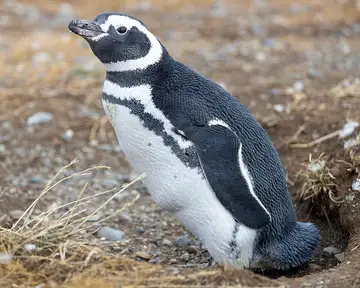
In Chile the most important breeding colony is at Isla Chanaral. In central Chile their range overlaps with the Magellanic penguin, and in at least two places in southern Chile the two species share colonies.
Fishing trips and diet
These penguins are visual hunters that leave their islands after sunrise. They mostly eat small schooling fish, such as anchovy, sardines and herring, and sometimes squid and crustaceans. Northern colonies eat mainly Atlantic saury and garfish.
Studies near Pan de Azucar found they usually forage within about 35 km of the colony, seize fish from below in short, shallow dives, and reach a maximum depth around 54 metres.
Nests, eggs and chicks
Most pairs lay two eggs about four days apart, and incubation takes about 41 days. Parents take shifts of about 2.5 days. They breed after moulting, when food is plentiful, and eggs can be laid from March to December. Half of the females manage two clutches a year.
Chicks hatch about two days apart, are guarded by one parent while the other fishes, and are fed once a day. Courtship is noisy: a bird stretches its head up, flaps its wings and brays like a donkey. Peruvians call the penguin pajaro-nino, meaning baby bird.
Fun facts
- It is named after the cold Humboldt Current, itself named after explorer Alexander von Humboldt.
- In 2002 one was caught in a fishing net off Alaska, the only wild penguin record in North America. Nobody knows if it was wild or an escaped pet.
- Its call sounds like a donkey bray.
- It is the heaviest penguin in its genus.
- Humboldt penguins lose their old feathers and grow new ones in about two weeks.
On the globe
Look for it on the Pacific coasts of Chile and Peru; the card shows its black chest band and pink bill skin.
Quiz time
Which is heavier: Humboldt penguin or Andean condor?
Show the answer
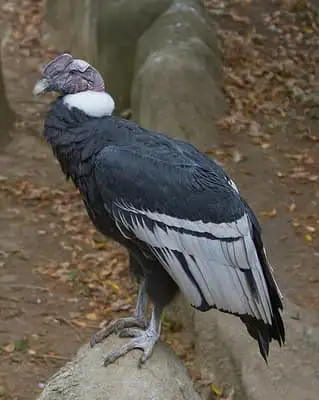
Andean condor. (4.5 kg vs 11 kg) Andean condor →
More like this
_-_469.jpg)
Sources
Updated: 2026-10-14