
Grey seal
회색물범
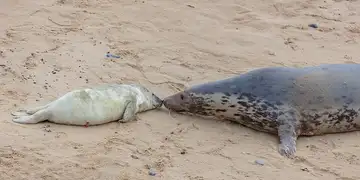
A big seal with a long, horse-like snout and grey mottled coat. Its Latin name means hook-nosed sea pig. Males weigh nearly 300 kg, and pups are born in a white coat. Large colonies rest on the shores of Britain and the Baltic Sea.
See it on the 3D globe →At a glance
- Class
- Mammals
- Lives in
- North Atlantic & Baltic Sea, British Isles
- Diet
- Fish eater
- Weight
- about 190 kg
- Length
- about 2.3 m
- Conservation status
- Least Concern (IUCN LC)
- Habitat
- coasts
Quick answers
Where does the Grey seal live?
It lives in coasts of the Atlantic Ocean. On the globe you can find it near North Atlantic & Baltic Sea, British Isles.
How big is the Grey seal?
It grows to about 2.3 m and 190 kg.
What does the Grey seal eat?
Its diet: fish eater.
Is the Grey seal endangered?
It is listed as Least Concern (IUCN LC).
The grey seal is a large true seal of the North Atlantic. It has a long, horse-like snout and a mottled grey coat, which is why it is also called the horsehead seal. In the east Atlantic adults are 1.6 to 2.3 metres long and weigh 100 to 310 kilograms, and in the west Atlantic they can reach 2.7 metres and 400 kilograms.
It lives on both sides of the North Atlantic and in the Baltic Sea. The largest populations are in Canada and the United Kingdom. Its scientific name, Halichoerus grypus, means hook-nosed sea pig. Because of its huge head, it is also known as the horsehead seal.
Food and enemies
Grey seals mostly eat fish, and sometimes octopus and lobster. Their main enemies are orcas, and sharks may hunt them too.
Seal pups are born with a white coat. They also have enemies of their own: eagles and gulls are often the main predators of the pups. Grey seals also eat crabs and squid when the fish are scarce. Gray seals can dive for fish to find a meal when they are hungry.
Two groups of grey seals
Scientists recognise two subspecies. The Baltic one lives in the Baltic Sea, and the Atlantic one lives everywhere else in the range.
Studies of their DNA show that seals in the eastern and western Atlantic have been separate for at least a million years, so they could one day be treated as separate subspecies. Seals from the Baltic Sea and from the Atlantic can be told apart by their genes.
Fun facts
- Its scientific name, Halichoerus grypus, means "hook-nosed sea pig".
- Its scientific name means hook-nosed sea pig.
- Pups are born in a white coat.
- Big colonies rest on the shores of Britain and the Baltic Sea.
On the globe
The globe places the grey seal in the North Atlantic and the Baltic Sea, around the British Isles. Look for the long snout.
Quiz time
Which is heavier: Grey seal or Eurasian beaver?
Show the answer
Grey seal. (190 kg vs 18 kg) Eurasian beaver →
More like this


,_playa_de_Horsey,_Norfolk,_Inglaterra,_2022-11-20,_DD_11.jpg)
Sources
Updated: 2026-10-14