
European hedgehog
유럽고슴도치
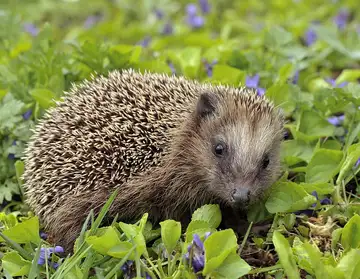
The European hedgehog is a small nocturnal mammal with about 6,000 to 8,000 spines on its back. When threatened it rolls into a tight ball, and it hunts beetles, worms and slugs in gardens and woods.
See it on the 3D globe →At a glance
- Class
- Mammals
- Lives in
- Woodlands and gardens of western and central Europe
- Diet
- Insect eater
- Weight
- about 1 kg
- Length
- about 0.25 m
- Top speed
- about 6 km/h
- Lifespan
- up to about 10 years
- Conservation status
- Near Threatened (IUCN NT)
- Habitat
- forests, grasslands, towns & cities
Quick answers
Where does the European hedgehog live?
It lives in forests, grasslands, towns & cities. On the globe you can find it near Woodlands and gardens of western and central Europe.
How big is the European hedgehog?
It grows to about 0.25 m and 1 kg.
What does the European hedgehog eat?
Its diet: insect eater.
How fast is the European hedgehog?
It can reach about 6 km/h.
How long does the European hedgehog live?
It can live up to about 10 years.
Is the European hedgehog endangered?
It is listed as Near Threatened (IUCN NT).
The European hedgehog, Erinaceus europaeus, is a small, mostly nocturnal mammal covered with up to about 6,000 brown and white spines. When it is frightened it curls into a tight, prickly ball. Adults are 26 cm or more in length with a tiny tail of only 2 to 3 cm, and an adult usually weighs between about 500 grams in summer and over a kilogram in autumn.
It lives across western and central Europe, from Spain and Italy north into Scandinavia and west to Ireland, in woods, hedges and gardens. People love it as a garden visitor because it eats pests such as slugs and beetles. Its numbers are stable in much of Europe, but in Great Britain it is declining severely and is now Red Listed.
What it eats
The hedgehog is an insectivore. Earthworms make up much of its diet, along with snails, slugs, beetles, ants, caterpillars, earwigs and many other insects. It also takes the eggs of ground-nesting birds, and sometimes lizards, frogs or small rodents. Plants are only a tiny part of what it eats.
It walks with a hesitant gait and often stops to sniff the air, which fits its night-time hunting.
Nests and babies
A hedgehog builds three kinds of nest: a breeding nest for the young, a day nest for summer, and a winter nest for long sleeps. Babies are usually born between May and July after a pregnancy of 31 to 35 days. A litter is typically four to six, though it can range from two to ten.
The newborns are blind and covered with small spines. After about 36 hours a second, outer coat of spines starts to grow, by 11 days they can roll into a ball, and they are weaned at around six weeks.
Dangers and winter
In winter the European hedgehog may hibernate, though most wake at least once to move their nest. Starvation is the most common cause of death, often during hibernation. They can live more than ten years, but three years is the average.
Foxes, badgers and pine martens sometimes eat them, and eagle-owls and golden eagles are the main birds that hunt them. Hedgehogs were taken to New Zealand in the 1860s to 1890s on ships, and there they became an invasive species.
Fun facts
- An adult hedgehog has about 5,000 to 7,000 spines and rolls into a prickly ball when scared.
- A hedgehog can have up to about 6,000 spines.
- Its weight can swing from about 500 g in summer to over 1 kg in autumn.
- About a quarter of hedgehogs on North Ronaldsay and Alderney are pale blonde ones with black eyes.
- Hedgehogs became so common in New Zealand that a bounty of one shilling a snout was once paid.
On the globe
The globe places the European hedgehog in woodlands and gardens of western and central Europe. Look for the spiny back.
Quiz time
Which is heavier: European hedgehog or Wild boar?
Show the answer
Wild boar. (1 kg vs 80 kg) Wild boar →
More like this


.jpg)
Sources
Updated: 2026-10-14