
Grizzly bear
회색곰
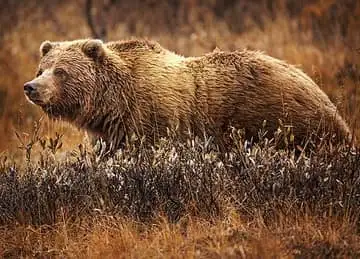
The grizzly bear has a muscular hump on its shoulders that powers its digging. In summer it fishes for salmon in Alaska's rivers, eating dozens a day to build the fat it needs for winter hibernation.
See it on the 3D globe →At a glance
- Class
- Mammals
- Lives in
- Katmai, Alaska, USA
- Diet
- Eats both plants and meat (omnivore)
- Weight
- about 220 kg
- Length
- about 2 m
- Top speed
- about 48 km/h
- Lifespan
- up to about 30 years
- Conservation status
- Least Concern (IUCN LC)
- Habitat
- forests, mountains, grasslands
Quick answers
Where does the Grizzly bear live?
It lives in forests, mountains, grasslands. On the globe you can find it near Katmai, Alaska, USA.
How big is the Grizzly bear?
It grows to about 2 m and 220 kg.
What does the Grizzly bear eat?
Its diet: eats both plants and meat (omnivore).
How fast is the Grizzly bear?
It can reach about 48 km/h.
How long does the Grizzly bear live?
It can live up to about 30 years.
Is the Grizzly bear endangered?
It is listed as Least Concern (IUCN LC).
The grizzly bear is a North American kind of brown bear. Its name comes from the grey, or grizzled, tips on its brown fur. The easiest way to recognise a grizzly is the big hump on its shoulders. That hump is a mass of muscle that gives its front legs the power to dig up roots, burrows and winter dens.
Grizzlies live mostly in Alaska and western Canada, with smaller groups in the northern Rocky Mountains of the United States, including Yellowstone. Coastal bears that feast on salmon grow much bigger than bears living far inland. On our globe, the grizzly stands in Katmai, Alaska, a place famous for bears catching salmon at the rivers each summer. These bears eat huge amounts of food in summer and autumn to build up the fat they need to survive a long winter sleep.
What it eats
Grizzlies belong to the meat-eating group of mammals, but they are really omnivores, eating both plants and animals. Depending on where they live, plants can make up most of their diet: berries, nuts, roots, grasses and flowers. They also dig up ground squirrels, eat insects and moths, and sometimes catch young elk or moose. Along the coasts of Alaska and British Columbia, salmon are a feast. Bears that catch plenty of fish often eat only the richest parts, leaving leftovers for gulls, ravens and foxes.
Family life
Adult grizzlies usually live alone, except for mothers with cubs, though many bears gather at rivers when the salmon are running. Cubs are born in the winter den while the mother is hibernating. They weigh only about 450 grams at birth, less than a loaf of bread, and there are usually two. The cubs drink their mother's milk in the den and stay with her for about two years, learning where to find food. A mother grizzly protects her cubs fiercely.
Is it endangered?
Worldwide, the brown bear species is listed as Least Concern, and tens of thousands of grizzlies still live in Alaska and Canada. In the rest of the United States, though, grizzlies disappeared from most of their old range. By the 1960s only a few hundred were left there, and they were listed as threatened in 1975. Thanks to protection, their numbers have grown again, to roughly 1,400 to 1,700 bears in the lower 48 states.
Fun facts
- The hump on its shoulders is a mass of muscle that powers its digging.
- A grizzly's front claws can be 5 to 10 centimetres long, about as long as your finger.
- Before winter, a grizzly can put on about 180 kilograms of extra weight.
- Grizzlies can sleep through the winter for five to seven months.
- Despite their size, grizzlies have been timed running at about 48 km/h.
- The extinct California grizzly still appears on the state flag of California.
On the globe
The model shows a grizzly bear with its muscular shoulder hump in Katmai, Alaska, where bears fish for salmon in summer. Zoom in to spot the hump that sets it apart from other bears.
Quiz time
Which is heavier: Grizzly bear or Steller sea lion?
Show the answer
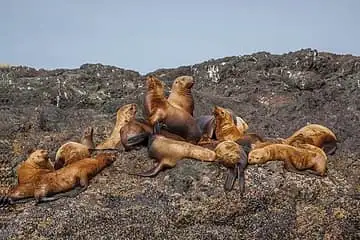
Steller sea lion. (220 kg vs 410 kg) Steller sea lion →
More like this

Sources
Updated: 2026-10-13