
Walrus
바다코끼리
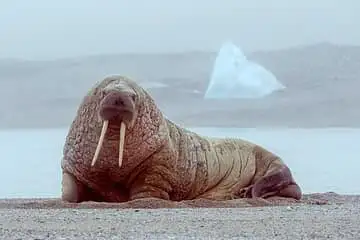
The walrus is a huge Arctic pinniped, with big males over a tonne. Its tusks, up to 1 m long, help haul it onto ice, and its sensitive whiskers feel along the seabed for clams to eat.
See it on the 3D globe →At a glance
- Class
- Mammals
- Lives in
- Chukchi Sea
- Diet
- Meat eater (carnivore)
- Weight
- about 1,000 kg
- Length
- about 2.9 m
- Top speed
- about 35 km/h
- Lifespan
- up to about 40 years
- Conservation status
- Vulnerable (IUCN VU)
- Habitat
- polar regions, coasts
Quick answers
Where does the Walrus live?
It lives in polar regions, coasts of the Arctic, Pacific and Atlantic oceans. On the globe you can find it near Chukchi Sea.
How big is the Walrus?
It grows to about 2.9 m and 1,000 kg.
What does the Walrus eat?
Its diet: meat eater (carnivore).
How fast is the Walrus?
It can reach about 35 km/h.
How long does the Walrus live?
It can live up to about 40 years.
Is the Walrus endangered?
It is listed as Vulnerable (IUCN VU).
The walrus is a huge, whiskered marine mammal that lives in the cold seas around the North Pole. It belongs to the pinnipeds, the flipper-footed group that also includes seals and sea lions, and it is the only living species in its family. Big males can weigh well over a tonne, and only elephant seals grow larger among pinnipeds.
Walruses spend much of their lives in shallow coastal waters and on floating sea ice, searching the seabed for clams. There are two main kinds: the Atlantic walrus, found from northeastern Canada to Greenland and Arctic Russia, and the Pacific walrus. On our globe the walrus lives in the Chukchi Sea, between Alaska and Siberia, where several hundred thousand Pacific walruses travel each summer from the Bering Sea.
Amazing body
A walrus's tusks are actually very long canine teeth that keep growing throughout its life. Both males and females have them, and they can reach about 1 metre long. Walruses hook their tusks onto the ice to pull their heavy bodies out of the water, and use them to keep breathing holes open. Under the skin is a layer of blubber up to 15 centimetres thick that keeps them warm. An air sac in the throat works like a built-in float, letting a walrus bob upright and even sleep in the water.
What it eats
Walruses eat mostly clams and other shellfish from the sea floor. To find them in dark, muddy water, they use 400 to 700 stiff whiskers, which are so sensitive they can feel the shape of tiny objects. A walrus clears mud away by blowing jets of water and fanning its flippers. Then it presses its strong lips against a clam and pulls back its tongue like a piston, sucking the soft meat right out of the shell. Walruses also eat crabs, shrimp, worms and sea cucumbers.
Is it endangered?
The IUCN lists the walrus as Vulnerable. In the 18th and 19th centuries walruses were hunted in huge numbers for their ivory, blubber and skin, and they vanished from places like the Gulf of St. Lawrence. Commercial hunting is now banned, and only Indigenous Arctic communities may hunt them. Today the biggest worry is melting sea ice, which takes away the platforms walruses need for resting near their feeding grounds.
Fun facts
- Both male and female walruses have tusks, which help them haul themselves out onto the ice.
- The walrus's scientific name, Odobenus, comes from Greek words meaning 'tooth walker'.
- A walrus's whiskers can be up to 30 centimetres long when they are not worn down.
- Old male walruses can turn almost pink.
- A newborn walrus calf can weigh as much as a grown-up person.
- Walruses are the only pinnipeds known to nurse their young in the water as well as on land or ice.
On the globe
The model shows a big walrus with long tusks in the Chukchi Sea, between Alaska and Siberia. Zoom in to look for its tusks and bushy whiskers.
Quiz time
Which is heavier: Walrus or Bowhead whale?
Show the answer
Bowhead whale. (1,000 kg vs 88,000 kg) Bowhead whale →
More like this

Sources
Updated: 2026-10-13