
Northern fur seal
북방물개
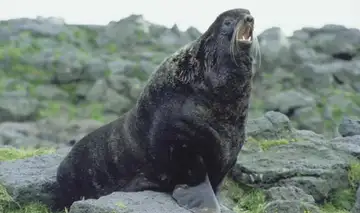
A fur seal with very dense dark fur, a small pointed nose and big foreflippers. Males are far larger than females, reaching about 270 kg. In summer huge numbers gather to breed on islands such as the Pribilofs in Alaska.
See it on the 3D globe →At a glance
- Class
- Mammals
- Lives in
- North Pacific, Pribilof & Commander Islands
- Diet
- Fish eater
- Conservation status
- Vulnerable (IUCN VU)
- Habitat
- coasts, open ocean
Quick answers
Where does the Northern fur seal live?
It lives in coasts, open ocean of the Pacific Ocean. On the globe you can find it near North Pacific, Pribilof & Commander Islands.
What does the Northern fur seal eat?
Its diet: fish eater.
Is the Northern fur seal endangered?
It is listed as Vulnerable (IUCN VU).
The northern fur seal is an eared seal of the North Pacific Ocean, the Bering Sea, the Sea of Japan and the Sea of Okhotsk. It is the largest member of the fur seal subfamily and the only living species in its genus, Callorhinus.
Its fur is thick and rich, with dense creamy underfur beneath long guard hairs. Its head looks short, with a small nose and a very short, down-curved muzzle. It lives across the North Pacific and ranges into the Bering Sea, the Sea of Japan and the Sea of Okhotsk. Pups are born with black pelts.
Big males, small females
Males are 30 to 40 percent longer and more than 4.5 times heavier than females, a huge size gap. The card puts a big male at around 270 kilograms. Pups are born with a black pelt that turns darker brown on the body and lighter on the chest and belly. The thick fur, with creamy underfur beneath the long guard hairs, keeps the animal warm in cold water and is partly visible when the animal is wet.
Flippers
The fore flippers have no fur on top, with a sharp line at the wrist where fur ends. The hind flippers are the proportionally longest of any eared seal, thanks to long cartilage extensions on the toes. Long whiskers often reach back beyond the ears. Its hind flippers are the longest in relation to body size of any eared seal, helping it move on land and swim.
Fun facts
- It spends most of the year at sea and comes ashore mainly to breed, on islands such as Alaska's Pribilofs.
- Fur seals gather in huge numbers to breed on islands such as the Pribilofs, according to the card.
- A fossil relative was found in California, Mexico and Japan.
- Its whiskers can stretch beyond its ears.
On the globe
The model shows a northern fur seal with dense dark fur and large front flippers.
More like this

Sources
Updated: 2026-10-14