
Harbor seal
잔점박이물범
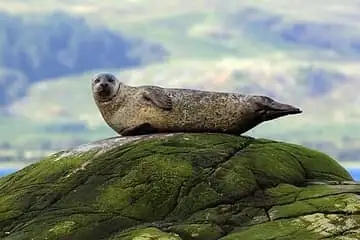
A seal with a scatter of small spots whose pattern is unique to each animal. Pups can swim within hours of birth, and adults can stay under for more than 20 minutes while hunting fish. They haul out on rocks and sandbars to rest.
See it on the 3D globe →At a glance
- Class
- Mammals
- Diet
- Fish eater
- Weight
- about 100 kg
- Length
- about 1.7 m
- Top speed
- about 19 km/h
- Lifespan
- up to about 30 years
- Conservation status
- Least Concern (IUCN LC)
- Habitat
- coasts
Quick answers
Where does the Harbor seal live?
It lives in coasts of the Atlantic, Pacific and Arctic oceans.
How big is the Harbor seal?
It grows to about 1.7 m and 100 kg.
What does the Harbor seal eat?
Its diet: fish eater.
How fast is the Harbor seal?
It can reach about 19 km/h.
How long does the Harbor seal live?
It can live up to about 30 years.
Is the Harbor seal endangered?
It is listed as Least Concern (IUCN LC).
The harbor seal, also called the common seal, is a true seal found along the cool and Arctic coasts of the Northern Hemisphere. It is the most widely spread seal of all, living in the North Atlantic and North Pacific, the Baltic Sea and the North Sea. It has a rounded head, V-shaped nostrils, and a coat that is brown, tan or grey with small spots.
Adults reach about 1.85 metres and 55 to 168 kilograms. Each seal has its own pattern of spots, like a fingerprint. Scientists estimate 350,000 to 500,000 harbor seals worldwide. Without ear flaps, it hears through small holes behind its eyes.
Pups that swim at once
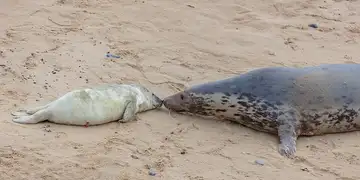
A female has one pup after nine months. She cares for it alone. The pup can swim and dive within hours of being born and grows fast on its mother's rich milk, which weans it in four to six weeks. A newborn can weigh up to about 16 kilograms.
Females live longer than males: about 30 to 35 years compared with 20 to 25 years.
Resting on land
Harbor seals hunt in the sea but climb out on rocks, sandbars, ice or mud to rest. These places are called haul-out sites, and the seals use the same familiar ones again and again.
Hunting seals was once common but it is now illegal in many countries. One freshwater group, the Ungava seal in northern Quebec, is endangered. Pups stay close to their mothers for the first few weeks. Their coats are brown, silvery white, tan or sometimes grey depending on where they live.
Fun facts
- Each harbor seal has its own pattern of spots, which scientists use to tell individuals apart.
- Every harbor seal has its own pattern of spots.
- Pups can swim and dive just a few hours after birth.
- It has no ear flaps, only a small hole behind each eye.
On the globe
The globe places the harbor seal along northern coasts. Look for the spotted coat and the round head.
Quiz time
Which is heavier: Harbor seal or Red fox?
Show the answer
Harbor seal. (100 kg vs 6 kg) Red fox →
More like this

_2.jpg)
Sources
Updated: 2026-10-14