
Orca
범고래
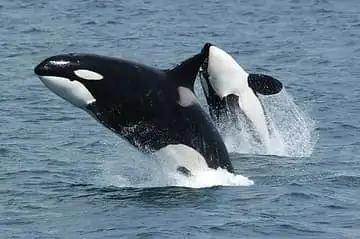
The largest member of the dolphin family, an apex predator that hunts in cooperative family pods. It swims at up to about 56 km/h, each pod has its own calls, and females can live 90 years or more. In Norway they follow herring.
See it on the 3D globe →At a glance
- Class
- Mammals
- Lives in
- Norwegian Sea
- Diet
- Meat eater (carnivore)
- Weight
- about 4,500 kg
- Length
- about 6.5 m
- Top speed
- about 56 km/h
- Lifespan
- up to about 90 years
- Conservation status
- Data Deficient (IUCN DD)
- Habitat
- open ocean, coasts, polar regions
Quick answers
Where does the Orca live?
It lives in open ocean, coasts, polar regions of the Pacific, Atlantic, Indian, Southern and Arctic oceans. On the globe you can find it near Norwegian Sea.
How big is the Orca?
It grows to about 6.5 m and 4,500 kg.
What does the Orca eat?
Its diet: meat eater (carnivore).
How fast is the Orca?
It can reach about 56 km/h.
How long does the Orca live?
It can live up to about 90 years.
Is the Orca endangered?
It is listed as Data Deficient (IUCN DD).
The orca, also called the killer whale, is the largest member of the dolphin family. It is easy to recognise by its black back, white belly and the white oval patch behind each eye. Orcas live in every ocean on Earth, from icy polar seas to warm tropical waters, but they are most common in cool coastal waters.
Orcas are apex predators, which means nothing in the sea hunts them. They live in close family groups called pods and hunt together, a little like a wolf pack. Different groups eat different food and even use different calls, which they learn from their mothers. Scientists see this as a kind of animal culture. On our globe, the orca swims in the Norwegian Sea, where some orcas follow huge schools of herring along the coast of Norway.
What it eats
Orcas eat many kinds of prey, but each population tends to specialise. Some groups in the northeast Pacific eat almost only salmon, while others hunt seals, dolphins and even large whales. In Norway, orcas use a trick called carousel feeding: they circle a school of herring, blow bubbles and flash their white bellies to push the fish into a tight ball, then slap it with their tails to stun several fish at once. Other groups have learned to catch sharks and rays.
Family life
An orca family is led by the oldest female, and her sons and daughters often stay with her for life. A mother is pregnant for 15 to 18 months and usually has one calf about every five years. Each pod has its own set of calls, called a dialect, so a family can be recognised by the way it sounds. Females stop having babies at around 40, but orcas are one of the very few animals that keep living for decades after that. NOAA says females can live to at least 90 years.
Is it endangered?
Around 50,000 orcas are thought to live worldwide. The IUCN lists the species as data deficient, which means scientists do not yet have enough information, partly because the different orca types may really be separate species. Some local groups are in trouble. The southern resident orcas near Washington State and British Columbia are endangered because of a shortage of salmon, pollution and noise from boats.
Fun facts
- Each orca pod has its own set of calls, a little like a family dialect.
- A newborn orca calf is about 2.4 metres long and weighs around 180 kilograms.
- An adult male's dorsal fin can stand about 1.8 metres tall, taller than most grown-ups.
- Orcas can swim at up to about 56 km/h in short bursts.
- Scientists can tell individual orcas apart by the nicks on their dorsal fins and the grey saddle patch behind them.
- There is no record of a wild orca ever killing a person.
On the globe
The model shows a black-and-white orca in the Norwegian Sea, where orcas follow schools of herring. Look for its tall dorsal fin cutting through the water.
Quiz time
Which is heavier: Orca or Wolverine?
Show the answer
Orca. (4,500 kg vs 12 kg) Wolverine →
More like this


Sources
Updated: 2026-10-13