
Hourglass dolphin
모래시계돌고래
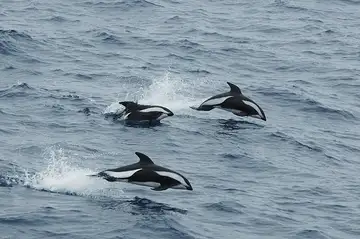
A small black-and-white dolphin whose white flank markings form an hourglass shape. It lives in cold Southern Ocean waters and often rides ships' bow waves. It is about 1.8 m long.
See it on the 3D globe →At a glance
- Class
- Mammals
- Lives in
- Drake Passage and Antarctic Convergence waters
- Diet
- Fish eater
- Length
- about 1.7 m
- Conservation status
- Least Concern (IUCN LC)
- Habitat
- polar regions, open ocean
Quick answers
Where does the Hourglass dolphin live?
It lives in polar regions, open ocean of the Southern Ocean. On the globe you can find it near Drake Passage and Antarctic Convergence waters.
How big is the Hourglass dolphin?
It grows to about 1.7 m.
What does the Hourglass dolphin eat?
Its diet: fish eater.
Is the Hourglass dolphin endangered?
It is listed as Least Concern (IUCN LC).
The hourglass dolphin, Cephalorhynchus cruciger, is a small black-and-white dolphin of cold, open waters around Antarctica and the sub-Antarctic. People often see it from ships crossing the Drake Passage, but it lives all the way around the Southern Ocean, roughly between 45 and 67 degrees south.
It gets its name from the white patches on each side of its body: one at the front and one at the back, joined by a thin white strip, which together look loosely like an hourglass. An adult male is about 1.8 metres long and weighs over 90 kilograms. Although it is small, it is fast and agile. It is rated Least Concern by the IUCN, with a survey-based estimate of about 144,300 animals.
A dolphin first known from a drawing
The species was named in 1824 by Jean René Constant Quoy and Joseph Paul Gaimard, from a drawing made in the South Pacific in 1820. It is the only whale or dolphin to have been widely accepted as a species based only on witness accounts.
Whalers called it a sea cow or sea skunk. Its scientific name cruciger means cross-carrier, because the black area on its back, seen from above, vaguely resembles a cross. Scientists once placed it in the genus Lagenorhynchus, but a 2025 revision moved it, with Peale's dolphin, into Cephalorhynchus.
Life in the Southern Ocean
These dolphins prefer cold surface water, from about minus 0.3 to 7 degrees Celsius. They move farther south in the austral summer and farther north in winter. Groups are usually 10 to 15 animals, though groups of up to 100 have been seen.
They feed alongside pilot whales, minke whales and southern right whale dolphins, and are often seen with fin whales. They like to bow-ride, swimming in the waves made by ships and big whales. Stomach contents of a few animals showed mantis shrimp, worms, squid and small fish.
What we still do not know
Hourglass dolphins have been studied very little. No calves have been confirmed in sightings, so the colour, size and diet of young ones are unknown. Females are thought to carry their young for about 12.9 months, and lifespan is estimated at 27 to 46 years by comparison with similar dolphins.
There are no known major threats, and the dolphin is covered by international conservation agreements and listed in CITES Appendix II.
Fun facts
- It is named for the white hourglass-shaped pattern on its black sides.
- It is the only cetacean widely accepted as a species from a drawing and eyewitness accounts alone.
- Whalers nicknamed it sea cow and sea skunk.
- Groups of up to 100 have been seen, though most are 10 to 15.
- Nobody has confirmed what a baby hourglass dolphin looks like.
On the globe
Look in the Drake Passage waters near Antarctica; the card describes the white hourglass on its black flanks.
Quiz time
Which is longer: Hourglass dolphin or Leopard seal?
Show the answer
Leopard seal. (1.7 m vs 3 m) Leopard seal →
More like this

Sources
Updated: 2026-10-14