
Leopard seal
표범물범
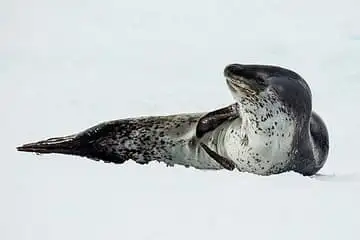
A spotted Antarctic top predator with huge jaws that hunts penguins. Around 3 m long and 400 kg, it lurks in the water at the ice edge to grab penguins, and it can also strain small krill from the sea.
See it on the 3D globe →At a glance
- Class
- Mammals
- Lives in
- Weddell Sea, Antarctica
- Diet
- Meat eater (carnivore)
- Length
- about 3 m
- Conservation status
- Least Concern (IUCN LC)
- Habitat
- polar regions, coasts
Quick answers
Where does the Leopard seal live?
It lives in polar regions, coasts of the Southern Ocean. On the globe you can find it near Weddell Sea, Antarctica.
How big is the Leopard seal?
It grows to about 3 m.
What does the Leopard seal eat?
Its diet: meat eater (carnivore).
Is the Leopard seal endangered?
It is listed as Least Concern (IUCN LC).
The leopard seal, Hydrurga leptonyx, is a long, muscular seal of the Southern Ocean around Antarctica and southern Patagonia. It is the second-largest seal in the Antarctic, after the southern elephant seal, and about as long as a walrus but usually less than half the weight. Adults are 2.4 to 3.5 metres long and weigh 200 to 600 kilograms, and females can be up to 50 percent larger than males.
Its coat is silver underneath and dark grey on top, with leopard-like dark spots. It is an apex predator with massive jaws and canine teeth up to 2.5 centimetres long. Its only natural enemy is the orca. It lives mainly around the pack ice and is thought to number between 220,000 and 440,000, which makes it Least Concern. It can live up to 26 years in the wild.
What it eats
Young leopard seals mostly eat krill, squid and fish. Adults take bigger, harder prey, famously penguins of many kinds, as well as other seals such as Weddell, crabeater and Ross seals, young elephant seals and fur seal pups.
Its back teeth lock together to sieve krill from the water, a trait shared by its relatives in the tribe Lobodontini. Underwater it tracks prey with its hearing and short, clear whiskers. Mostly it dives shallow, but it can go deeper than 80 metres by collapsing its lungs and reinflating them at the surface. Cooperative hunting of fur seal pups has been seen.
Life on the ice
Leopard seals are ice-loving, or pagophilic. They mostly live in the Antarctic pack ice between 50 and 80 degrees south, and are most common in West Antarctica. Most live alone, except for a mother and her pup. Some groups move north in winter to sub-Antarctic islands, and a population seems to live in Chilean Patagonia and New Zealand.
Vagrants have turned up as far as Australia, South Africa, Easter Island and the Cook Islands. They spend long periods singing under water in spring and summer, so scientists often study them with underwater microphones. Their front flippers are very large, which makes them agile hunters.
People and leopard seals
A leopard seal is a big predator and could be dangerous, but attacks on people are rare. Many stories come from early Antarctic exploration. In Shackleton's 1914 to 1917 expedition, a sea leopard about 3.7 metres long chased a man across the ice until a companion shot it.
In 1985 an explorer was bitten twice on the leg when a seal tried to drag him into the sea, and his friends kicked it with spiked crampons. A French zoologist, Henri de Blainville, described the species in 1820 from a stuffed specimen, and the genus Hydrurga was named in 1848.
Fun facts
- It is the only seal that regularly hunts warm-blooded prey such as penguins and other seals.
- It is as long as a walrus but about half the weight.
- Its back teeth can lock together like a sieve to strain krill.
- Females are up to 50 percent larger than males.
- It can dive deeper than 80 metres by collapsing its lungs.
On the globe
The model shows a spotted leopard seal near the Antarctic ice, hunting penguins.
Quiz time
Which is longer: Leopard seal or Hourglass dolphin?
Show the answer
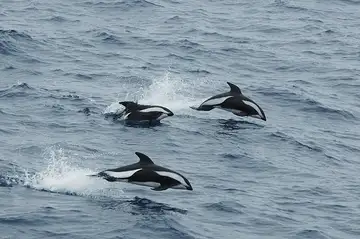
Leopard seal. (3 m vs 1.7 m) Hourglass dolphin →
More like this
_04.jpg)
Sources
Updated: 2026-10-14