
Patagonian mara
파타고니아마라
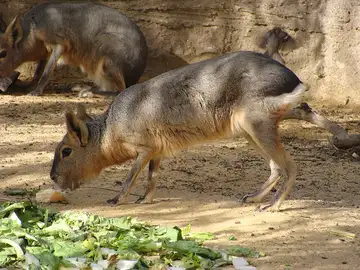
A large hare-like rodent of the Patagonian steppe in Argentina. Its long legs let it run and bound at up to about 45 km/h, and pairs stay together for life, often leaving their pups in a shared communal burrow.
See it on the 3D globe →At a glance
- Class
- Mammals
- Lives in
- Patagonia, Argentina
- Diet
- Plant eater (herbivore)
- Weight
- about 12 kg
- Length
- about 0.72 m
- Conservation status
- Near Threatened (IUCN NT)
- Habitat
- grasslands, deserts
Quick answers
Where does the Patagonian mara live?
It lives in grasslands, deserts. On the globe you can find it near Patagonia, Argentina.
How big is the Patagonian mara?
It grows to about 0.72 m and 12 kg.
What does the Patagonian mara eat?
Its diet: plant eater (herbivore).
Is the Patagonian mara endangered?
It is listed as Near Threatened (IUCN NT).
The Patagonian mara (Dolichotis patagonum) is a big rodent that looks like a jackrabbit on long legs. It is also known as the Patagonian cavy or Patagonian hare. It has upright ears, a grey back, and a white patch on its rump separated from the back fur by a black area. The head and body measure 69 to 75 centimetres, the tail is only 4 to 5 centimetres, and the animal weighs 8 to 16 kilograms.
It lives in open and semi-open land in Argentina, including large parts of Patagonia, between about 28 and 50 degrees south, and it is found in the wild only in Argentina. Its feet are squeezed into hoof-like shapes, so when it stands or walks it can look like a small deer. Maras are herbivores, and the species is rated near threatened.
Running on the steppe
Maras prefer areas with shrubs, but they also live on overgrazed, barren ground in the Monte Desert, and in sandy, low-shrub country on the Valdes Peninsula. Long legs, reduced collarbones and sharp senses let them run and communicate across open plains, and when they run they have been compared to deer and antelope.
They eat mostly green plants and fruit, and about 46 percent of their day is spent feeding. They are mainly active in daylight, and the females feed more than males because of pregnancy and nursing. Males spend much of the day sitting and watching for predators such as cats, foxes and birds of prey.
Pairs for life
Maras are monogamous. A pair stays together for life, and a new partner is taken only after one dies. The male does almost all of the work of keeping the pair together by following the female wherever she goes, marking her and the ground around her so that she carries a moving territory.
Even so, up to 29 pairs may share one breeding warren. In southern Argentina they breed from August to January, pregnancy lasts about 100 days, and most Patagonian births come in September and October.
Life in the den
Pups can walk almost right after birth. The parents dig dens, and the litters of one to 22 pairs are grouped together. Living together protects young from predators, and survival is higher in larger groups. One pair visits the den at a time for about an hour while the others circle around it.
Mothers do not actively cooperate in raising young, and a female may chase away pups that are not her own, though some pups steal milk. For the first three weeks pups stay near the den, huddling, grooming and playing. They are weaned at 13 weeks.
Fun facts
- This large rodent looks like a small deer or hare, and pairs usually stay together for life.
- The mara is also called the Patagonian cavy or Patagonian hare.
- Its feet are compressed and hoof-like.
- Maras are related to guinea pigs and capybaras.
- Mara pups can walk almost immediately after birth.
On the globe
The model shows a Patagonian mara in Patagonia, Argentina. Look for its long legs and big ears.
Quiz time
Which is heavier: Patagonian mara or Southern pudú?
Show the answer
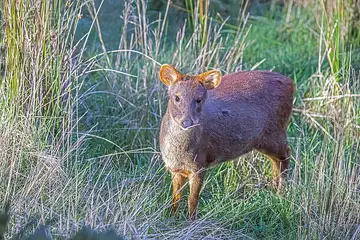
Patagonian mara. (12 kg vs 10 kg) Southern pudú →
More like this

Sources
Updated: 2026-10-14