
Indri
인드리
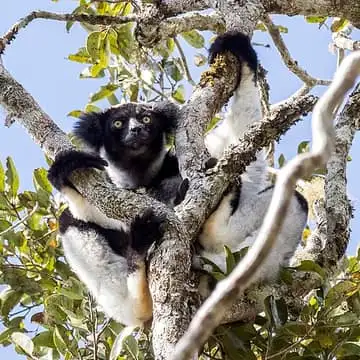
The largest living lemur, from Madagascar's rainforests, with almost no tail and a talent for leaping between upright tree trunks. Its family wailing songs carry about 2 km through the forest, and it is critically endangered.
See it on the 3D globe →At a glance
- Class
- Mammals
- Diet
- Plant eater (herbivore)
- Weight
- about 7.5 kg
- Length
- about 0.7 m
- Conservation status
- Critically Endangered (IUCN CR)
- Habitat
- rainforests
Quick answers
Where does the Indri live?
It lives in rainforests.
How big is the Indri?
It grows to about 0.7 m and 7.5 kg.
What does the Indri eat?
Its diet: plant eater (herbivore).
Is the Indri endangered?
It is listed as Critically Endangered (IUCN CR).
The indri, Indri indri, also called the babakoto, is one of the largest living lemurs, with a head-body length of about 64 to 72 cm and a weight of 6 to 9.5 kg. It lives in the lowland and mountain rainforests along the eastern coast of Madagascar. Its coat is black with white patches, and unlike any other living lemur it has only a tiny tail.
The indri clings to tree trunks and leaps from one to another, holding its body upright. It is active in the daytime and eats mainly leaves, preferring young, tender ones, plus some seeds, fruit and flowers. It is revered by the Malagasy people, and many myths tell of its origin. The IUCN rates it Critically Endangered, mainly because of habitat loss from slash-and-burn farming, firewood gathering and logging, and because it is still hunted despite taboos.
Songs of the rainforest
Indri families sing loud, haunting songs that last from 45 seconds to more than 3 minutes. A song often begins with a roar from nearly everyone, then the adult pair leads long notes followed by wails that slide from high to low. Two or more animals often time the falling notes together, like a duet.
Neighbouring groups answer each other, which may mark territory and boundaries. A group sings almost every day, peaking between 7 and 11 in the morning. Before singing, the indri climb to the treetops, so the sound carries up to about 4 km.
Family life
Indris pair up for the long term and look for a new mate only after one dies. A group is usually the pair and their growing young. As in many lemurs, females are in charge: the dominant female often pushes males to lower branches and leads the group when it travels.
Females have a single baby every two to three years, usually born in May or June after 120 to 150 days of pregnancy. The baby is mostly or completely black, rides on the mother's belly at first, then moves to her back at four or five months, and is fully independent only after at least two years.
A name with stories
The word indri probably comes from the Malagasy name endrina. A popular story says it comes from indry, meaning there it is, but that is not correct. The French naturalist Pierre Sonnerat first described the animal.
The other name, babakoto, is usually translated as ancestor or father. Koto means little boy and baba means father, so it can also read as father of a little boy. Many legends about its origin have a father and son in them. Indris reach adulthood at 7 to 9 years old.
Fun facts
- Indri families sing loud, wailing songs that carry far through the forest.
- It is the largest living lemur, tied with the diademed sifaka.
- Its only tail is a stub, unlike any other living lemur.
- Songs can be heard up to about 4 km away.
- Some northern indris are almost entirely black.
On the globe
Find it in the rainforest of Madagascar; the card points out its near-absent tail and upright posture.
Quiz time
Which is heavier: Indri or Aye-aye?
Show the answer
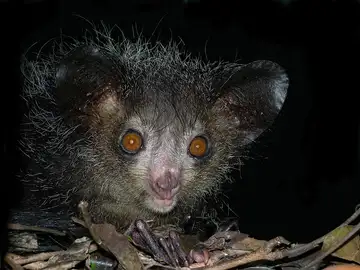
Indri. (7.5 kg vs 2.5 kg) Aye-aye →
More like this

.jpg)
Sources
Updated: 2026-10-14