
Aye-aye
아이아이
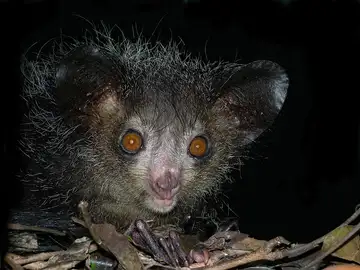
A nocturnal lemur of Madagascar and the largest nocturnal primate in the world. It taps on wood to find hollow tunnels, then hooks out grubs with its extremely long, thin middle finger.
See it on the 3D globe →At a glance
- Class
- Mammals
- Lives in
- Rainforests of northeastern Madagascar
- Diet
- Eats both plants and meat (omnivore)
- Weight
- about 2.5 kg
- Length
- about 0.8 m
- Conservation status
- Endangered (IUCN EN)
- Habitat
- rainforests
Quick answers
Where does the Aye-aye live?
It lives in rainforests. On the globe you can find it near Rainforests of northeastern Madagascar.
How big is the Aye-aye?
It grows to about 0.8 m and 2.5 kg.
What does the Aye-aye eat?
Its diet: eats both plants and meat (omnivore).
Is the Aye-aye endangered?
It is listed as Endangered (IUCN EN).
The aye-aye is a strange-looking lemur that lives only in Madagascar, in the rainforests of the northeast. It is the world's largest nocturnal primate, which means it is active at night. It has rodent-like teeth that never stop growing and one very thin middle finger.
It finds food in an unusual way called percussive foraging. It taps on tree trunks and listens for the echo that shows a hollow tunnel inside, then gnaws a small hole and hooks out the grubs with its long finger. In the forest it fills the same job as a woodpecker. It is classed as Endangered by the IUCN.
Tap, listen, dig
Percussive foraging takes between 5 and 41 percent of the aye-aye's foraging time. The only other living mammals known to find food this way are the striped possum and trioks of northern Australia and New Guinea, which are marsupials. A full-grown aye-aye is about 60 cm long, with a tail that is even longer than its body.
Names and relatives
The French naturalist Pierre Sonnerat first used the name 'aye-aye' in 1782. He said it was a cry of astonishment, but another idea is that it comes from the Malagasy word 'hai hai', or from 'heh heh', which means 'I don't know' and may be what people said to avoid naming a feared, magical animal. A second, larger aye-aye species, Daubentonia robusta, died out within the last 1,000 years. It is known only from subfossil bones.
What kind of animal is it?
Early scientists were puzzled. Because its front teeth never stop growing like a rodent's, they put it with the squirrels and rodents. It also has a head, eyes and ears that resemble a cat's. Today DNA studies place it as the oldest branch of the lemurs, which probably rafted from Africa to Madagascar long ago. The aye-aye is the only living member of its genus and family.
Fun facts
- It taps on wood with its long, thin middle finger and listens for hollow tunnels where grubs hide.
- It is the world's largest nocturnal primate.
- Its front teeth grow all through its life.
- It taps on wood like a woodpecker and listens for hollow tunnels.
- A second, larger aye-aye species died out within the last 1,000 years.
On the globe
The model shows the aye-aye with its long, thin middle finger, as in the card. Look at that finger and its big eyes.
Quiz time
Which is heavier: Aye-aye or Indri?
Show the answer
Indri. (2.5 kg vs 7.5 kg) Indri →
More like this
,_Tsimbazaza_Zoo,_Madagascar_(3897947810).jpg)
Sources
Updated: 2026-10-14