
Fossa
포사
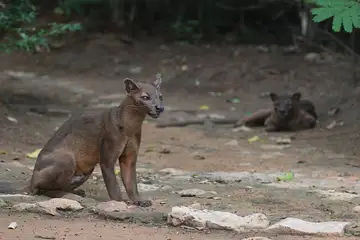
Madagascar's largest carnivorous mammal, weighing about 10 kg, with a tail as long as its body for balance. An agile climber, it preys mostly on lemurs. It looks catlike but is related to mongooses.
See it on the 3D globe →At a glance
- Class
- Mammals
- Lives in
- Forests of Madagascar
- Diet
- Meat eater (carnivore)
- Weight
- about 7 kg
- Length
- about 1.4 m
- Conservation status
- Vulnerable (IUCN VU)
- Habitat
- forests
Quick answers
Where does the Fossa live?
It lives in forests. On the globe you can find it near Forests of Madagascar.
How big is the Fossa?
It grows to about 1.4 m and 7 kg.
What does the Fossa eat?
Its diet: meat eater (carnivore).
Is the Fossa endangered?
It is listed as Vulnerable (IUCN VU).
The fossa, Cryptoprocta ferox, is a slender, long-tailed, cat-like mammal found only on Madagascar. It is the island's largest meat-eating mammal, and people have compared it to a small cougar because it has evolved many cat-like features. It belongs to the family Eupleridae, so its closest relatives are other Malagasy carnivores, not true cats.
An adult is 70 to 80 cm long, not counting a tail that is about as long as the body, and weighs 5.5 to 8.6 kg. Males are bigger than females. The fossa lives only in forest, is found across much of the island at low population densities, and hunts both day and night. The IUCN lists it as vulnerable. The name is Malagasy and sounds a bit like FOO-sa.
An expert climber
The fossa has semi-retractable claws, which means it can stick them out but cannot pull them fully back in. Its ankles are flexible, so it can climb up and down trees head-first and jump from tree to tree.
More than half of what it eats is lemurs, the primates found only on Madagascar. It also hunts tenrecs, rodents, lizards, birds and other animals.
Family life
Mating usually takes place in trees, on horizontal limbs, and can last for several hours. A mother has one to six pups, which are born blind and toothless. They are weaned after about 4.5 months and independent after a year. A fossa reaches adulthood at around three to four years old and can live about 20 years in captivity.
Many Malagasy people fear the fossa, and a taboo called fady often protects it. The greatest threat to it is the loss of its forest home.
A puzzling relative
For a long time scientists could not agree where the fossa belonged. It looks like a cat, and its first describer, Edward Turner Bennett, treated it as a kind of civet. Later it was put with cats, then with civets again, then with mongooses.
Genetic studies in the 2000s showed that all native Malagasy carnivores share one ancestor and form their own family, Eupleridae. Their ancestors are thought to have reached the island just once, around 18 to 20 million years ago. Two larger extinct relatives are also known from the island.
Fun facts
- It looks like a cat but is related to mongooses, and more than half of its prey are lemurs.
- More than half of its diet is lemurs.
- It can climb down a tree head-first.
- Its scientific name Cryptoprocta refers to a hidden anal pouch, and ferox means fierce.
- Fossas look like cats, but DNA shows they are not closely related to cats.
On the globe
The fossa lives in the forests of Madagascar. Look for the slim body and tail as long as its body.
Quiz time
Which is heavier: Fossa or Ring-tailed lemur?
Show the answer
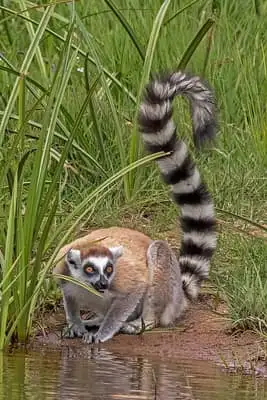
Fossa. (7 kg vs 2.2 kg) Ring-tailed lemur →
More like this

Sources
Updated: 2026-10-14