
Japanese macaque
일본원숭이
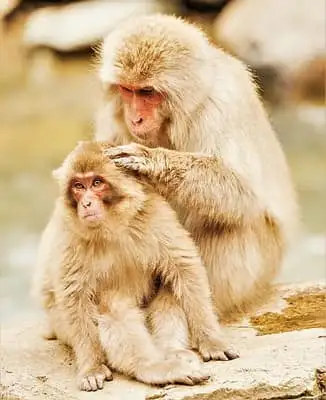
The Japanese macaque is the world's most northerly monkey and lives where snow lies deep. Some troops soak in hot springs to keep warm in winter, and their faces and bottoms are bright red.
See it on the 3D globe →At a glance
- Class
- Mammals
- Lives in
- Shimokita Peninsula, Aomori, Japan
- Diet
- Eats both plants and meat (omnivore)
- Weight
- about 10 kg
- Length
- about 0.6 m
- Lifespan
- up to about 32 years
- Conservation status
- Least Concern (IUCN LC)
- Habitat
- forests, mountains
Quick answers
Where does the Japanese macaque live?
It lives in forests, mountains. On the globe you can find it near Shimokita Peninsula, Aomori, Japan.
How big is the Japanese macaque?
It grows to about 0.6 m and 10 kg.
What does the Japanese macaque eat?
Its diet: eats both plants and meat (omnivore).
How long does the Japanese macaque live?
It can live up to about 32 years.
Is the Japanese macaque endangered?
It is listed as Least Concern (IUCN LC).
The Japanese macaque, Macaca fuscata, also called the snow monkey, is a monkey that lives only in Japan. No other non-human primate lives farther north or in a colder climate. It has brownish-grey fur, a pinkish-red face and a short stump of a tail. Its Japanese name is Nihonzaru. It is the only native monkey in Japan, so when people there simply say saru, they usually mean this one.
It lives on three of Japan's four main islands, Honshu, Shikoku and Kyushu, from the Shimokita Peninsula in the north to Yakushima in the south. Males weigh about 11.3 kg and females about 8.4 kg, and macaques from colder areas tend to be heavier. The coat grows thicker as temperatures fall, and the monkeys can cope with -20 degrees Celsius. The species is rated Least Concern.
Troops and leaders
Japanese macaques live in matrilineal troops: females stay in the troop they were born in for life, while males leave before they are adult. A troop often holds several families of related females, and a young female's rank depends on her mother's. Males have their own ranking, with one alpha male, and a male's rank tends to rise the longer he stays.
In 2021 a female named Yakei became leader of a troop of 677 monkeys at the Takasakiyama sanctuary in Japan. At age nine she overthrew the dominant males and displaced her own mother, the first female leader in the troop's 70 recorded years.
Food and winter
Macaques are omnivores. More than 213 plant species are on the menu, plus insects, bark, soil, flowers and fungi. On Yakushima they eat mostly fruit in summer and herbs in winter. Farther north they eat fruit and nuts to build fat for the winter, when food is scarce.
They usually sleep in trees and huddle together for warmth in cold weather. At Jigokudani Monkey Park, macaques visit hot springs in winter to warm up, a habit that began in the 1960s when they were encouraged to gather there to reduce crop damage. They are also good swimmers and have swum more than half a kilometre.
Babies and grooming
A mother gives birth on the ground, usually away from the rest of the troop. Newborns have dark-brown hair. She carries the baby on her belly for the first four weeks, then on her back too. The baby tries solid food at five to six weeks and forages on its own by seven weeks, and it is fully weaned by about 18 months.
Grooming keeps hygiene and friendships going. Related females groom each other most, and mothers pass their grooming techniques on to their young, probably as a cultural habit. Females can live up to 32 years, a long time for a macaque.
Fun facts
- Some troops bathe in hot springs in winter to keep warm.
- It is the northernmost-living monkey, and no other non-human primate lives in a colder climate.
- A female named Yakei led a 677-monkey troop in 2021, the first female leader in 70 years of records.
- Macaques have been seen swimming more than half a kilometre.
- About 150 macaques moved from Kyoto to Texas in 1972, and by 1995 the troop had grown to 500 to 600.
On the globe
Find it on the Shimokita Peninsula in Aomori, Japan; the card shows the red face and the hot-spring habit.
Quiz time
Which is heavier: Japanese macaque or Raccoon dog?
Show the answer
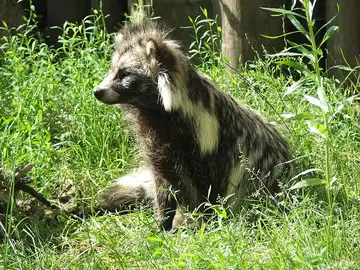
Japanese macaque. (10 kg vs 6 kg) Raccoon dog →
More like this
_Mother_Grooms_Her_Young.jpg)
Sources
Updated: 2026-10-14