
Ribbon seal
띠무늬물범
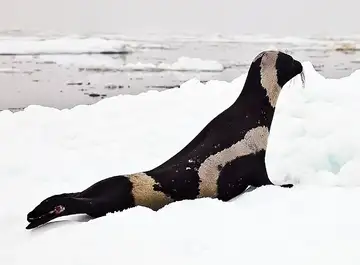
A dark seal with four broad white bands around the neck, flippers and hips. It breeds on drifting pack ice in the Bering and Okhotsk Seas and spends most of the year at sea.
See it on the 3D globe →At a glance
- Class
- Mammals
- Lives in
- Pack ice of the Bering and Okhotsk Seas
- Diet
- Meat eater (carnivore)
- Length
- about 1.6 m
- Conservation status
- Least Concern (IUCN LC)
- Habitat
- polar regions
Quick answers
Where does the Ribbon seal live?
It lives in polar regions of the Pacific and Arctic oceans. On the globe you can find it near Pack ice of the Bering and Okhotsk Seas.
How big is the Ribbon seal?
It grows to about 1.6 m.
What does the Ribbon seal eat?
Its diet: meat eater (carnivore).
Is the Ribbon seal endangered?
It is listed as Least Concern (IUCN LC).
The ribbon seal is a medium-sized seal that is easy to recognise. It is dark brown or black with four broad white markings: a band around the neck, a band around the hips, and a ring on each side that encloses the front flipper. Adults grow to about 1.6 metres and 95 kilograms, and males are larger than females.
It lives in the cold North Pacific and the Arctic, mainly in the Bering Sea and the Sea of Okhotsk. In winter and spring it rests, breeds and moults on drifting pack ice at the ice front. The rest of the year it lives far out at sea, so very little is known about its life then. It is rarely seen from land, and the IUCN lists it as Least Concern.
White pups, striped adults
Ribbon seal pups are born with white fur. After they shed it, the pups turn blue-grey on top and silvery below. Over the next three years the fur keeps getting darker in some places and lighter in others, and only at about four years old does the striking striped pattern appear. The contrast is clearer in males, while in females the pattern is often less obvious.
A built-in air bag
Ribbon seals have a big inflatable air sac connected to the windpipe that stretches along the right side over the ribs. It is bigger in males, and scientists think it helps make underwater sounds, maybe to attract a mate. Orcas and great white sharks hunt ribbon seals. A seal of this kind was recorded in the 1920s near the Taedong River in Korea, and the species is listed as protected there.
Fun facts
- Adult males have bold white ribbon-like bands on dark fur around the neck, flippers and hips.
- Four white marks on dark fur make the ribbon seal one of the easiest seals to recognise.
- Ribbon seal pups are white, and the ribbon pattern shows only at age four.
- Males have a large inflatable air sac that may help them make sounds underwater.
On the globe
The globe places the ribbon seal on the pack ice of the Bering and Okhotsk Seas. Look for the white bands on its dark body.
Quiz time
Which is longer: Ribbon seal or Dall's porpoise?
Show the answer
Dall's porpoise. (1.6 m vs 2 m) Dall's porpoise →
More like this



_(cropped).jpg)
Sources
Updated: 2026-10-14