
Llama
라마
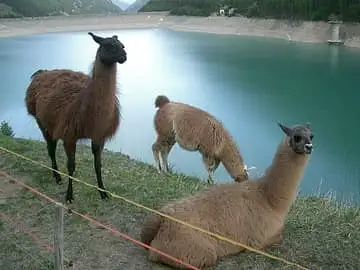
The llama is a pack animal the Andean peoples have used for thousands of years. It can carry about a quarter of its own weight over high mountain trails, and an annoyed llama may spit at you.
See it on the 3D globe →At a glance
- Class
- Mammals
- Lives in
- Altiplano, northern Chile
- Diet
- Plant eater (herbivore)
- Weight
- about 160 kg
- Lifespan
- up to about 25 years
- Habitat
- mountains, grasslands
Quick answers
Where does the Llama live?
It lives in mountains, grasslands. On the globe you can find it near Altiplano, northern Chile.
How big is the Llama?
It grows to about 160 kg.
What does the Llama eat?
Its diet: plant eater (herbivore).
How long does the Llama live?
It can live up to about 25 years.
The llama is a long-necked, woolly animal from the Andes mountains of South America. It belongs to the camel family, together with the alpaca and two wild cousins, the guanaco and the vicuña. Unlike camels, llamas have no hump. A grown llama is about as tall as an adult person at the top of its head and usually weighs somewhere between 130 and 200 kilograms.
Llamas are not wild animals. People in the Andean highlands tamed them from wild guanacos roughly 4,000 to 5,000 years ago, which makes them one of the oldest farm animals in the world. For the Inca Empire they were the only pack animals, carrying goods along steep mountain trails. Andean families also used their wool and meat, and even their dung as fertilizer. Today llamas live in many countries, but most are still in Peru, Bolivia, Chile and Argentina.
Where it lives
Llamas come from the Altiplano, a high, cold and windy plateau in the Andes where few trees grow. They cope well with thin mountain air and rough ground. Each foot has two toes with soft, leathery pads underneath, which grip rocky paths and do little damage to the ground. Their thick coat keeps them warm on freezing nights, and it comes in many colours, from white to brown, red and black, sometimes with spots.
What it eats
Llamas are plant-eaters. They graze on grasses and other plants and can live on rough, poor-quality food. Their stomach has three chambers that help break down tough plant fibres, and they bring food back up to chew it again, a bit like cows. A long gut helps them save water, which is useful in dry places. On a farm, a llama eats mostly pasture and hay.
Family life and behaviour
Llamas are social and live in herds. They talk to each other with body postures, ear and tail movements and a soft humming sound, and they give an alarm call when danger is near. Spitting is mostly used on other llamas, for example to settle who gets the food; a well-raised llama rarely spits at people. A mother carries her baby for about 11 and a half months and has one baby, called a cria, which stands and drinks milk within about an hour of being born.
Fun facts
- Llamas were domesticated in the Andes more than 4,000 years ago.
- A baby llama is called a cria, and it can usually stand up within an hour of birth.
- Llamas hum to each other to keep in touch.
- In North America, some farmers keep llamas as guards to protect sheep from coyotes and dogs.
- A llama can carry about a quarter of its own body weight on its back.
On the globe
The model shows a llama on the high Altiplano plateau of northern Chile, the kind of pack animal Andean peoples have used for thousands of years. Look for it in the mountains near the west coast of South America.
Quiz time
Which is heavier: Llama or Vicuña?
Show the answer
Llama. (160 kg vs 50 kg) Vicuña →
More like this


Sources
- Read more on Wikipedia
- Llama — Wikipedia
- Llamas and Alpacas (Fact sheet FS917) — Rutgers Cooperative Research & Extension
Updated: 2026-10-13