
Vicuña
비쿠냐
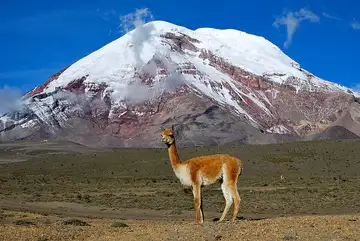
The smallest camelid, living on the high Andean plateau at about 3,500 to 5,700 m. Its extremely fine wool is among the most precious natural fibres, and in Inca times only royalty could wear it.
See it on the 3D globe →At a glance
- Class
- Mammals
- Lives in
- Andean highlands, Bolivia and Peru
- Diet
- Plant eater (herbivore)
- Weight
- about 50 kg
- Conservation status
- Least Concern (IUCN LC)
- Habitat
- mountains, grasslands
Quick answers
Where does the Vicuña live?
It lives in mountains, grasslands. On the globe you can find it near Andean highlands, Bolivia and Peru.
How big is the Vicuña?
It grows to about 50 kg.
What does the Vicuña eat?
Its diet: plant eater (herbivore).
Is the Vicuña endangered?
It is listed as Least Concern (IUCN LC).
The vicuña is a wild relative of the llama that lives high in the Andes, in cold, thin air at around 3,500 to 5,700 metres. It is the smallest of the South American camelids and has a light, slim build, a tawny back and long white fur on its chest.
It is Peru's national animal and appears on the country's coat of arms. The vicuña is believed to be the ancestor of the alpaca, and it grows some of the finest and most expensive wool in the world. It stays in herds on the high grasslands, where few other large animals can find food.
Why was its wool so special?
Each vicuña produces only a small amount of extremely fine wool. It can be shorn only about every three years, and the animal must be caught from the wild to do it, so the cloth is very expensive.
In Inca times, only royalty were allowed to wear vicuña clothing. Even today local communities hold special rituals with the animals. Fine fibre and slow shearing are why vicuña cloth has been valued for centuries.
Was it almost lost?
Vicuñas were heavily hunted, and by 1974 only about 6,000 were left, so they were declared endangered. Strong protection helped them recover to about 350,000 today.
Conservation groups have lowered the level of threat, yet they still call for active programmes against poaching and habitat loss. Today people still perform a fertility rite with them, a sign of how important they are to Andean culture.
Fun facts
- It is Peru's national animal and grows some of the finest, most expensive wool in the world.
- Its wool is among the finest in the world.
- Only Inca royalty could wear vicuña cloth.
- From about 6,000 animals in 1974, the population has grown to around 350,000.
On the globe
The model shows a slim, tawny vicuña with a white chest on a high Andean plateau.
Quiz time
Which is heavier: Vicuña or Llama?
Show the answer
Llama. (50 kg vs 160 kg) Llama →
More like this

Sources
Updated: 2026-10-14