
Scarlet macaw
홍금강앵무
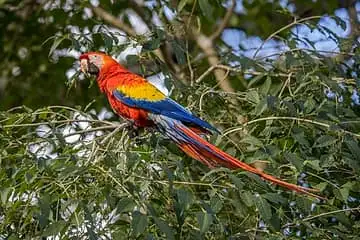
A brilliantly red, yellow and blue parrot whose powerful beak cracks the hardest nuts. In the Peruvian Amazon, flocks gather at riverbank clay cliffs to eat soil, probably to neutralise toxins in seeds. It can live for decades.
See it on the 3D globe →At a glance
- Class
- Birds
- Lives in
- Peruvian Amazon
- Diet
- Plant eater (herbivore)
- Weight
- about 1 kg
- Length
- about 0.81 m
- Top speed
- about 56 km/h
- Lifespan
- up to about 75 years
- Conservation status
- Least Concern (IUCN LC)
- Habitat
- rainforests
Quick answers
Where does the Scarlet macaw live?
It lives in rainforests. On the globe you can find it near Peruvian Amazon.
How big is the Scarlet macaw?
It grows to about 0.81 m and 1 kg.
What does the Scarlet macaw eat?
Its diet: plant eater (herbivore).
How fast is the Scarlet macaw?
It can reach about 56 km/h.
How long does the Scarlet macaw live?
It can live up to about 75 years.
Is the Scarlet macaw endangered?
It is listed as Least Concern (IUCN LC).
The scarlet macaw, Ara macao, is a large red, yellow, green and blue parrot of the humid evergreen forests of the Americas. Its range runs from southeastern Mexico to Peru, Ecuador, Colombia, Bolivia, Venezuela, Honduras and Brazil, and it also lives on Trinidad and the Pacific island of Coiba. It is the national bird of Honduras.
An adult is about 84 centimetres long, more than half of that the long pointed tail, and weighs about a kilogram. It is mostly scarlet, with yellow wing patches, a blue rump and dark-blue flight feathers, and bare white skin around the eye. In some areas it has disappeared because forests were destroyed or birds were captured for the parrot trade, but overall it is rated Least Concern, with 50,000 to 499,999 birds in the wild.
Loud flocks and clay licks
Scarlet macaws make very loud, throaty squawks and screams that carry for many kilometres to call their groups. They feed on fruits, nuts, seeds, flowers and nectar. Its strong beak cracks the hardest nuts. They sometimes visit natural mineral deposits, called licks, in clay riverbanks and eat the earth, which helps them get nutrients such as sodium and calcium.
In Costa Rica, they have learned to eat introduced teak and almond trees planted along the coast, which helped the local population grow.
Partners for life
Scarlet macaws are usually calm but can be fiercely aggressive when breeding. They are monogamous and stay with one partner throughout their lives. The female lays two or three white eggs in a large tree cavity and incubates them for about five weeks. The chicks leave the nest about 90 days after hatching and stay with their parents about a year longer.
Young birds reach sexual maturity at five years. In captivity macaws can live to 75 or even 90 years, though 40 to 50 is more typical.
Two kinds and conservation
There are two subspecies. The South American one has green tips on its wing feathers, while the larger Central American one, which averages 89 centimetres, has blue there. Linnaeus described the species in 1758, and its genome was sequenced in 2013.
International trade is banned by CITES Appendix I because of poaching for the pet trade. The northern subspecies is listed as endangered by the US, with only about 2,000 to 3,000 left. In Costa Rica, scientists move weak chicks to hand-rearing centres, because adults sometimes kill chicks when food and nest sites are short.
Fun facts
- The scarlet macaw is the national bird of Honduras.
- Its call can be heard many kilometres away.
- It is the national bird of Honduras.
- In captivity it can live up to 75 or even 90 years.
- Its genome was sequenced in 2013.
On the globe
The model shows a bright scarlet macaw in the rainforests of Central and South America.
Quiz time
Which is heavier: Scarlet macaw or Harpy eagle?
Show the answer
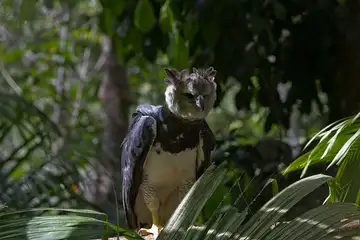
Harpy eagle. (1 kg vs 6 kg) Harpy eagle →
More like this

_Copan.jpg)
Sources
Updated: 2026-10-14