
Mandrill
맨드릴
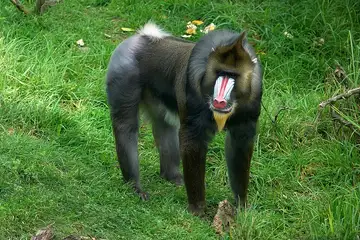
The mandrill is the largest monkey. Males have a red-and-blue face and a brightly coloured rump. It lives in rainforests of central Africa in big groups, sometimes hundreds strong, eating fruit and insects.
See it on the 3D globe →At a glance
- Class
- Mammals
- Lives in
- Rainforests of Gabon, Cameroon and Congo
- Diet
- Eats both plants and meat (omnivore)
- Weight
- about 18 kg
- Length
- about 0.8 m
- Lifespan
- up to about 40 years
- Conservation status
- Vulnerable (IUCN VU)
- Habitat
- rainforests
Quick answers
Where does the Mandrill live?
It lives in rainforests. On the globe you can find it near Rainforests of Gabon, Cameroon and Congo.
How big is the Mandrill?
It grows to about 0.8 m and 18 kg.
What does the Mandrill eat?
Its diet: eats both plants and meat (omnivore).
How long does the Mandrill live?
It can live up to about 40 years.
Is the Mandrill endangered?
It is listed as Vulnerable (IUCN VU).
The mandrill, Mandrillus sphinx, is the largest monkey in the world and one of the most colourful mammals. It lives in the tropical rainforests of west central Africa and sometimes crosses savannas. Its face and rear carry red and blue skin: a red stripe runs down the middle of the face to a red nose, with ridged blue skin on both sides. Its coat is olive-brown with a yellow-orange beard.
Males are far bigger than females, the most extreme size difference of any primate. Males are 70 to 95 centimetres long and weigh 19 to 30 kilograms, with canine teeth up to 4.5 centimetres, while females weigh 10 to 15 kilograms. Its closest relative is the drill. Both were once thought to be baboons, but they are closer to white-eyelid mangabeys. The IUCN lists the mandrill as Vulnerable.
Hordes of hundreds
Mandrills live in huge groups called hordes. At Lope National Park in Gabon the average horde had about 620 animals and some had 845, perhaps the largest cohesive groups of wild primates. One horde of 625 held 21 dominant males, 247 adult and young females, 200 juveniles and 86 infants.
Females and their relatives form the core of a horde, and strong family links help in fights and improve the survival of their young. Adult males mostly live alone and join the horde in the breeding season. A horde of about 700 had a home range of 182 square kilometres.
Colours and rank
A male's colours show his rank. When a male becomes the top male, his face and rear get redder, his chest glands make more scent, and his sides and rump get fatter. If he loses his rank, these changes partly reverse. Dominant males have the most contrast between red and blue and father the most young.
Males mostly settle rank with sounds and faces rather than fights. Mating is mostly in the dry season. Their preferred foods are fruit and seeds, but mandrills also eat leaves, mushrooms and animals from insects to young bay duikers.
Name and threats
The name mandrill comes from man and drill, a West African word for baboon or ape, and dates to 1744. Conrad Gessner drew the animal in 1551 to 1558 and thought it was a hyena. Linnaeus gave it a scientific name in 1758.
Habitat loss and hunting for bushmeat are the main threats, and the population may have fallen by more than 30 percent over 24 years. Gabon is considered the species' stronghold. The mandrill is in CITES Appendix I, which bans commercial trade in wild-caught animals.
Fun facts
- The mandrill is the largest monkey, and males have bright red and blue faces.
- It is the largest monkey in the world.
- A horde in Gabon had as many as 845 mandrills.
- A top male's face and rump get redder, and he gets fatter on the sides.
- Conrad Gessner drew it in the 1500s and thought it was a kind of hyena.
On the globe
The model shows a mandrill with its red-and-blue face in the rainforest of central Africa.
Quiz time
Which is heavier: Mandrill or Gorilla?
Show the answer
Gorilla. (18 kg vs 120 kg) Gorilla →
More like this

Sources
Updated: 2026-10-14