
Honey badger
벌꿀오소리
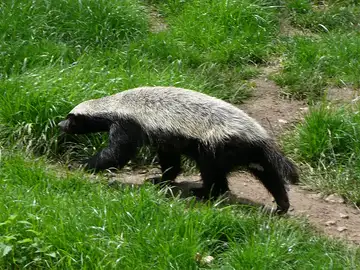
The honey badger is a small but famously fearless hunter. Its thick loose skin helps it survive stings and bites, and it raids beehives for honey and grubs, besides hunting snakes and rodents.
See it on the 3D globe →At a glance
- Class
- Mammals
- Lives in
- African and southwest Asian savannas and deserts
- Diet
- Eats both plants and meat (omnivore)
- Weight
- about 10 kg
- Length
- about 0.9 m
- Top speed
- about 30 km/h
- Lifespan
- up to about 24 years
- Conservation status
- Least Concern (IUCN LC)
- Habitat
- savannas, deserts, forests, grasslands
Quick answers
Where does the Honey badger live?
It lives in savannas, deserts, forests, grasslands. On the globe you can find it near African and southwest Asian savannas and deserts.
How big is the Honey badger?
It grows to about 0.9 m and 10 kg.
What does the Honey badger eat?
Its diet: eats both plants and meat (omnivore).
How fast is the Honey badger?
It can reach about 30 km/h.
How long does the Honey badger live?
It can live up to about 24 years.
Is the Honey badger endangered?
It is listed as Least Concern (IUCN LC).
The honey badger, also called the ratel, is a small but famously tough hunter that lives across Africa, Southwest Asia and the Indian subcontinent. It measures about 55 to 77 centimetres long and weighs up to 16 kilograms, which makes it the largest land member of the weasel family in Africa.
It is built low and thick-set, with very loose skin that lets it twist around inside it. It has few natural predators because of its strong body and fierce defence. Honey badgers raid beehives for honey and grubs, and hunt snakes and rodents, so the story of their courage is mostly true.
A body made for trouble
The honey badger has a broad back and remarkably loose skin, so if something grabs it, the badger can turn and bite back. This helps explain its reputation as a fearless animal. The card on the globe adds that its thick skin helps it survive stings and bites. It is mainly a meat eater, and it can be active at different times of day depending on where it lives.
Family life
Honey badgers live alone and keep large home ranges, marking them with scent. They have no fixed breeding season. After a pregnancy of 50 to 70 days, a mother usually has one or two cubs, and she looks after them for around a year or a bit more. Because it lives in many habitats over a wide area, the species is rated Least Concern.
Fun facts
- Its thick, loose skin lets it twist around to bite attackers, and it can survive cobra bites.
- Its skin is so loose that it can twist around inside it when grabbed.
- It is the only living species in its genus, Mellivora.
- Cubs stay with their mother for up to about a year and a quarter.
On the globe
Look for it on African and southwest Asian savanna and desert; the card describes its thick loose skin and its taste for honey.
Quiz time
Which is heavier: Honey badger or Aardvark?
Show the answer
Aardvark. (10 kg vs 70 kg) Aardvark →
More like this


Sources
Updated: 2026-10-14