
Nubian ibex
누비아아이벡스
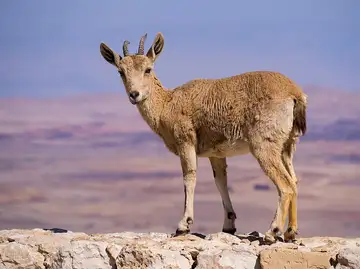
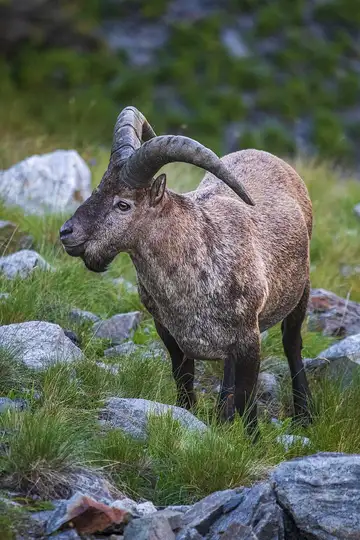
A wild goat of the dry, rocky cliffs of the Middle East and northeast Africa. Males carry ridged, sweeping horns that can exceed 1 m, and they climb steep rock with ease.
See it on the 3D globe →At a glance
- Class
- Mammals
- Lives in
- Desert cliffs of Sinai, Israel, Saudi Arabia and neighbours
- Diet
- Plant eater (herbivore)
- Conservation status
- Vulnerable (IUCN VU)
- Habitat
- deserts, mountains
Quick answers
Where does the Nubian ibex live?
It lives in deserts, mountains. On the globe you can find it near Desert cliffs of Sinai, Israel, Saudi Arabia and neighbours.
What does the Nubian ibex eat?
Its diet: plant eater (herbivore).
Is the Nubian ibex endangered?
It is listed as Vulnerable (IUCN VU).
The Nubian ibex (Capra nubiana) is a desert-dwelling wild goat that lives in mountainous areas of northern and northeast Africa and the Middle East. Today its range lies within Egypt, Jordan, Oman, Israel, Palestine, Saudi Arabia and Sudan. For a long time it was treated as a subspecies of the Alpine ibex, but scientists now recognise it as a species of its own.
It is the smallest ibex, standing 65 to 75 centimetres at the shoulder. Males weigh about 52 to 75 kilograms, much more than females at 25 to 33 kilograms. Both have long thin horns that sweep up and then back, nearly one metre long in males and about 30 centimetres in females. About 4,500 mature animals are estimated to remain in the wild, and the IUCN classes the species as vulnerable.
How it got its name
The French scientist Frédéric Cuvier first described it in 1825, drawing it under the label wild goat of Upper Egypt. It was classed as a subspecies of the Alpine ibex, and other early researchers used the name Sinai ibex. Hans-Peter Uerpmann, in a 1987 book, was the first widely recognised researcher to treat it as a separate species.
Its oldest remains in the Palestine region are about 150,000 years old, and it has lived there ever since, even after domestic goats arrived. Bones show it has been hunted by the Arabian leopard throughout the last 11,700 years or so.
Life on the cliffs
Nubian ibex live in rough, dry mountains and eat mainly grasses and leaves, especially from acacia trees. They may rear up on their hind legs, or even climb into trees, to reach leaves. They like to feed close to cliffs where they can escape danger, and the farther they are from a cliff, the more watchful they become.
Predators include Arabian leopards, wolves, golden jackals, caracals, golden eagles and bearded vultures. When alarmed, an ibex gives a shrill call to warn the others. A small bird, Tristram's starling, eats parasites off its skin.
Looks and rock art
The coat is light tan with a white belly, and males have a dark brown mane down the back and a beard that grows longer and darker with age. In autumn some mature males grow very dark rutting fur on the chest and sides. Male horns have thick bulges that stop them sliding when males lock horns in combat.
Ibex have appeared in petroglyphs, pottery and metalwork across the ancient Near East for thousands of years, sometimes shown beside stars or suns. They were hunted with dogs, nets and desert kites, which are long walls that narrow into a trap.
Fun facts
- Males have huge, ridged horns that curve back over their bodies, and they climb steep desert cliffs with ease.
- It was once thought to be a kind of Alpine ibex.
- Only about 4,500 mature animals are estimated to live in the wild.
- Its earliest remains in the Palestine region are about 150,000 years old.
- Female ibex in Oman have been recorded chewing small bone pieces, probably to get extra calcium and phosphorus.
On the globe
The model shows a Nubian ibex with large swept-back ridged horns on dry rocks.
More like this

.jpg)
Sources
Updated: 2026-10-14