
West Caucasian tur
코카서스투르
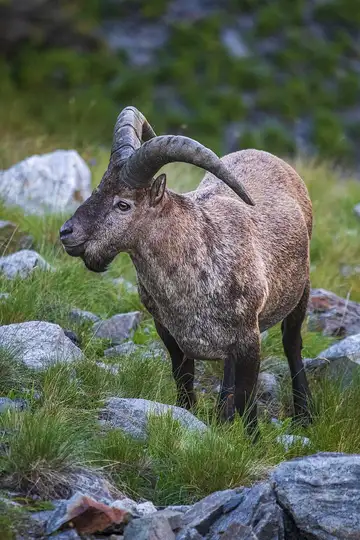
The West Caucasian tur is a wild goat found only in the western Caucasus mountains. It has a thick neck and heavy horns that sweep backward, much larger on males than on females. It climbs to the snow line in summer and moves down toward the forests in winter.
See it on the 3D globe →At a glance
- Class
- Mammals
- Lives in
- Western Caucasus mountains
- Diet
- Plant eater (herbivore)
- Weight
- about 70 kg
- Conservation status
- Endangered (IUCN EN)
- Habitat
- mountains
Quick answers
Where does the West Caucasian tur live?
It lives in mountains. On the globe you can find it near Western Caucasus mountains.
How big is the West Caucasian tur?
It grows to about 70 kg.
What does the West Caucasian tur eat?
Its diet: plant eater (herbivore).
Is the West Caucasian tur endangered?
It is listed as Endangered (IUCN EN).
The West Caucasian tur is a wild mountain goat that lives only in the western half of the Caucasus Mountains, in Georgia and southern Russia. It has a thick neck and a chestnut coat with a yellowish belly, and its heavy curved horns sweep back like scimitars. Its range is only about 4,500 square kilometres, and it is found nowhere else on Earth.
Males are bigger than females and have much longer horns, about 70 centimetres. The tur lives in rough, rocky terrain between 800 and 4,000 metres above sea level. Only about 3,000 to 4,000 of these animals are left in the wild, so the IUCN lists the species as Endangered.
Life on the mountain
In summer turs climb up near the snow line and live in herds of about ten animals. In winter the herds grow to around twenty and move down toward the forests. They are mostly active at night, feeding in the open on grasses and leaves and sheltering in the day. They stand up to one metre at the shoulder and weigh around 65 kilograms. Wolves and lynxes hunt them, and avalanches kill many.
Why is it endangered?
The tur's home range is only about 4,500 square kilometres, much smaller than it was before the 20th century. Grazing livestock take its pastures, harsh winters hit the herds, and poachers hunt it for meat, skin and horns. The horns are made into traditional drinking horns called kantsi. Hunting is fully protected in Georgia, but in Russia it can be hunted legally in autumn.
Fun facts
- It lives only in the western Greater Caucasus mountains of Russia and Georgia.
- Males have horns of around 70 centimetres.
- It lives between 800 and 4,000 metres above sea level.
- In the Ice Age the species lived as far away as southern France.
- Its horns are used to make drinking horns called kantsi.
On the globe
The model stands in the mountains of the western Caucasus. Look for the heavy horns that sweep backward.
Quiz time
Which is heavier: West Caucasian tur or Harbour porpoise?
Show the answer
West Caucasian tur. (70 kg vs 55 kg) Harbour porpoise →
More like this

Sources
Updated: 2026-10-14