
Peacock mantis shrimp
공작갯가재
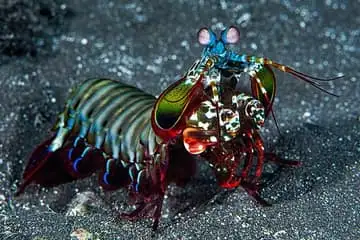
The mantis shrimp swings its club-like limbs at around 80 km/h, hard enough to smash snail shells and even crack aquarium glass. Its eyes can detect many more kinds of colour than ours. Most are about 10 to 18 cm long.
See it on the 3D globe →At a glance
- Class
- Crustaceans
- Diet
- Meat eater (carnivore)
- Habitat
- coral reefs
Quick answers
Where does the Peacock mantis shrimp live?
It lives in coral reefs of the Indian and Pacific oceans.
What does the Peacock mantis shrimp eat?
Its diet: meat eater (carnivore).
The peacock mantis shrimp (Odontodactylus scyllarus) is a large, colourful crustacean that lives on the seabed of the Indo-Pacific, from the Mariana Islands to East Africa and as far south as northern KwaZulu-Natal in South Africa. It is mostly green with orange legs and leopard-like spots on its front shell, and it measures between 3 and 18 centimetres. Other names include harlequin, painted, clown and rainbow mantis shrimp.
It is one of roughly 480 species of mantis shrimp, a group famous for fast raptorial claws, exceptional eyes and unusual ways of dealing with other sea animals. Aquarium keepers often prize it for its beauty, yet others treat it as a dangerous pest, because a hungry mantis shrimp can wreck a tank full of fish.
A spring-loaded hammer
Its weapon is the dactyl club, a hammer-like limb that works like a spring-loaded trap. The tip of the club, the impact region, is made mainly of a very dense mineral called hydroxyapatite, packed in a highly crystalline form that softens the shock of the blow. The club is also about five times thicker at the point of contact than other limb parts.
It is reported to strike at over 80 km/h, the fastest recorded punch of any living animal. The strike is so fast that bubbles form in the water, and when those bubbles pop they release heat that weakens the armour of its prey.
Eyes unlike ours
Mantis shrimp eyes hold 12 types of light-sensing cells, which let the animal tell colours apart and also see linear and circular polarised light, a kind of light that humans cannot see. A strip across the middle of each eye, the midband, has six rows of tiny lenses: four rows handle colour and two handle polarised light.
Because this species can read circularly polarised light, scientists have asked whether the way its eyes work could be copied to read CDs and similar optical storage.
A burrowing hunter
The peacock mantis shrimp digs U-shaped burrows in loose sand and rubble near the base of coral reefs, in water 3 to 40 metres deep. From there it hunts snails, crabs and other crustaceans, and shellfish such as scallops. It is a smasher: it hits the hard shell again and again until it can reach the soft body inside.
In aquariums, big ones can crack glass and tunnel through live rock, which is why some keepers call them pests.
Fun facts
- It strikes with club-like claws so fast that it can smash snail shells and even crack aquarium glass.
- It can strike at roughly 80 km/h, and the strike is fast enough to form tiny bubbles in the water.
- Its eyes have 12 types of light-sensing cells.
- Its nickname is thumb splitter, a warning about what it can do to a finger.
- The genus name Odontodactylus means tooth finger in Greek.
On the globe
The model shows a colourful mantis shrimp with its club-like limbs on a reef seafloor.
More like this


Sources
Updated: 2026-10-14