
Giant Antarctic isopod
남극바다쥐며느리
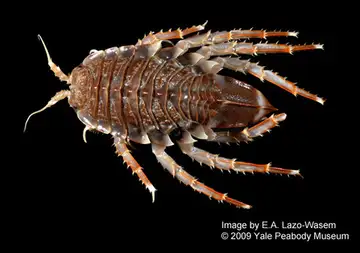
A Southern Ocean seabed crustacean related to woodlice but usually about 9 cm long and rarely up to 20 cm. It has an armoured, segmented back and seven pairs of legs, and scavenges and preys on small animals.
See it on the 3D globe →At a glance
- Class
- Crustaceans
- Lives in
- Seabed off East Antarctica (about 64°S, 100°E)
- Diet
- Scavenger
- Habitat
- polar regions
Quick answers
Where does the Giant Antarctic isopod live?
It lives in polar regions of the Southern Ocean. On the globe you can find it near Seabed off East Antarctica (about 64°S, 100°E).
What does the Giant Antarctic isopod eat?
Its diet: scavenger.
Glyptonotus antarcticus is a giant sea cousin of the woodlouse you might find under a garden stone. It lives on the cold seabed of the Southern Ocean around Antarctica, from shallow water down to more than 600 metres deep. Most isopods are only about a centimetre long, but this one is usually up to 9 cm and rarely reaches 20 cm, so it counts as a true giant.
It is a hunter and a scavenger. It eats many animals on the seabed, especially spiny sea creatures called echinoderms, and it will even eat its own kind. Its armoured, segmented back and tiny feathery hairs make it look like a little tank from an ancient world.
How does it live on the seabed?
It crawls along the bottom in icy water and is often caught in baited traps, which shows how willingly it feeds on dead or dying animals. Its eyes are unusual: it has only five tiny lens units, grouped into two pairs of eyes, a large pair on its back and a smaller pair underneath. Scientists think the lower eyes help when it swims, because it swims upside down.
Slow and careful parents
Females can breed once they are at least 7.5 cm long, and they can breed in any month of the year. They keep their eggs and young safely with them for a very long time, more than a year and a half. A genetic study in 2005 also hinted that this animal may really be several look-alike species hiding under one name.
Fun facts
- Most isopods measure between 0.5 and 1.5 cm, so a 9 cm Glyptonotus is huge by comparison.
- It swims upside down, and it has a second small pair of eyes underneath to help.
- Tiny feathery hairs and bumps cover its body, which may stop other small creatures from sticking to it.
- Mothers look after their eggs and young for more than 1.5 years.
On the globe
The model shows the armoured, segmented back of a seabed isopod, as in the card. Look for its row of plates and its many legs.
More like this
.jpeg)
Sources
Updated: 2026-10-14