
Antarctic krill
남극크릴
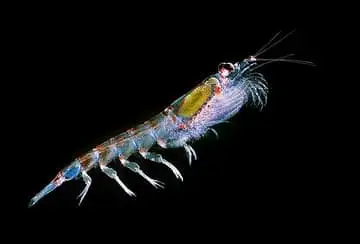
A crustacean only about 6 cm long, yet so many live in the Southern Ocean that it is one of the most abundant animals on Earth. It is a key food for whales, penguins and seals, and it can glow with its own light.
See it on the 3D globe →At a glance
- Class
- Crustaceans
- Lives in
- Southern Ocean
- Diet
- Filter feeder
- Weight
- about 0.002 kg
- Length
- about 0.06 m
- Lifespan
- up to about 6 years
- Conservation status
- Least Concern (IUCN LC)
- Habitat
- open ocean, polar regions
Quick answers
Where does the Antarctic krill live?
It lives in open ocean, polar regions of the Southern Ocean. On the globe you can find it near Southern Ocean.
How big is the Antarctic krill?
It grows to about 0.06 m and 0.002 kg.
What does the Antarctic krill eat?
Its diet: filter feeder.
How long does the Antarctic krill live?
It can live up to about 6 years.
Is the Antarctic krill endangered?
It is listed as Least Concern (IUCN LC).
Antarctic krill (Euphausia superba) is a small, shrimp-like swimmer of the icy Southern Ocean around Antarctica. An adult is only about 6 centimetres long and weighs up to 2 grams, yet krill gather in schools called swarms that can hold 10,000 to 30,000 animals in a single cubic metre of water.
All those tiny bodies add up. Scientists estimate that the total weight of Antarctic krill is around 500 million metric tons, which makes it one of the most abundant animal species on the planet. Whales, seals, penguins and fish all depend on it for food, so a lot of Antarctic life rests on this small crustacean.
What does krill eat?
Krill eat phytoplankton, the microscopic plants that float near the sunlit surface of the sea. Phytoplankton make their food from sunlight, so when krill eat them, the Sun's energy is passed along to the animals that eat krill in turn.
Because krill sit so close to the bottom of the food chain, they are a link between the tiny plants of the ocean and giants such as whales. Krill can also make their own light, which is called bioluminescence.
Life cycle and a surprising journey
Krill spawn mainly from January to March. A female lays 6,000 to 10,000 eggs at a time, and the eggs sink deep, to around 2,000 to 3,000 metres in some ocean areas.
After hatching, the young swim upward in a trip called the developmental ascent. It takes about three weeks to reach the surface waters. Krill become adults after two to three years and can live up to six years. People now fish for krill, and overfishing is a worry for this key species.
Fun facts
- Antarctic krill is a key food for whales, seals, penguins and fish in the Southern Ocean.
- A swarm can pack 10,000 to 30,000 krill into one cubic metre of water.
- The whole population of Antarctic krill weighs roughly 500 million metric tons.
- Female krill lay thousands of eggs, and the eggs sink thousands of metres before the babies swim back up.
- Krill can live for up to six years.
On the globe
The model shows a small krill in the Southern Ocean around Antarctica, where the real animals gather in huge swarms.
Quiz time
Which is heavier: Antarctic krill or American lobster?
Show the answer
American lobster. (0.002 kg vs 0.8 kg) American lobster →
More like this
.jpg)
Sources
Updated: 2026-10-14