
Scarlet cleaner shrimp
청소새우
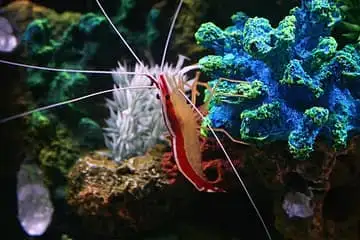
A tiny shrimp that runs a "cleaning station" on the reef, eating parasites and dead skin off larger fish. It waves its white antennae to attract customers, and even predatory fish wait patiently to be cleaned. A classic case of mutual benefit.
See it on the 3D globe →At a glance
- Class
- Crustaceans
- Diet
- Eats both plants and meat (omnivore)
- Habitat
- coral reefs
Quick answers
Where does the Scarlet cleaner shrimp live?
It lives in coral reefs of the Indian and Pacific oceans.
What does the Scarlet cleaner shrimp eat?
Its diet: eats both plants and meat (omnivore).
The scarlet cleaner shrimp, also called the skunk cleaner shrimp (Lysmata amboinensis), is a tiny reef shrimp that runs a cleaning station. It lives on tropical coral reefs from the Red Sea across the Indo-Pacific, usually in caves or under ledges at depths of 5 to 40 metres.
It is only 5 to 6 centimetres long, with a white stripe down its back flanked by scarlet red bands, and long white antennae. Fish line up to be cleaned of parasites and dead tissue, and the shrimp gets a meal. This kind of partnership, where both sides benefit, is called mutualism.
How does a cleaning station work?
The shrimp waves its long white antennae to advertise its service. A visiting fish stays still, sometimes even a large predator, while the shrimp climbs over its body and picks off parasites and dead skin. Eating this makes up a large part of the shrimp's diet. The reef benefits as well, because cleaned fish stay healthier. In fact, cleaner shrimp are a natural part of a healthy coral reef.
An unusual life story
Eggs are carried on the shrimp's swimming legs, and the larvae have a long drifting stage in the sea. Young shrimp start out as males and become functional hermaphrodites when they mature, able to act as both. Experiments suggest they have coarse vision and are colour blind. They are popular in home and public aquariums, where their cleaning can also be watched.
Fun facts
- It runs "cleaning stations" where fish line up to have parasites and dead skin picked off.
- It is born male and later becomes a functional hermaphrodite.
- Fish queue up at its cleaning station.
- It waves white antennae 3 to 5 inches long to attract customers.
- Experiments suggest it is colour blind.
On the globe
No special place is given on the card. Zoom into a coral reef and watch for a small shrimp waving its white antennae.
More like this

Sources
Updated: 2026-10-14