
American lobster
바닷가재(아메리칸 랍스터)
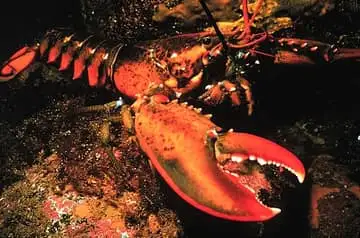
A sea crustacean with one crushing claw and one cutting claw. It sheds its hard shell many times as it grows, and its blood is blue because it carries copper instead of iron to move oxygen.
See it on the 3D globe →At a glance
- Class
- Crustaceans
- Diet
- Eats both plants and meat (omnivore)
- Weight
- about 0.8 kg
- Length
- about 0.23 m
- Lifespan
- up to about 100 years
- Conservation status
- Least Concern (IUCN LC)
- Habitat
- coasts
Quick answers
Where does the American lobster live?
It lives in coasts of the Atlantic Ocean.
How big is the American lobster?
It grows to about 0.23 m and 0.8 kg.
What does the American lobster eat?
Its diet: eats both plants and meat (omnivore).
How long does the American lobster live?
It can live up to about 100 years.
Is the American lobster endangered?
It is listed as Least Concern (IUCN LC).
The American lobster, Homarus americanus, lives on the Atlantic coast of North America, mainly from Labrador in the north down to Cape Hatteras, North Carolina. It is also called the Atlantic, northern or Maine lobster. Its body can be up to 64 centimetres long, not counting the claws. It is the heaviest crustacean and the heaviest living arthropod in the world. Most adults weigh between 0.45 and 4 kilograms, but the record is a lobster caught off Nova Scotia that weighed over 20 kilograms.
Its closest relative is the European lobster, and the two can be told apart by their claw spines: red or red-tipped in the American lobster, white or white-tipped in the European one. Its natural colour is bluish green to brown, and it turns bright red when cooked because of a pigment called astaxanthin. It lives in cold, rocky, shallow waters, usually at 4 to 50 metres.
Two different claws
The first pair of legs carries a big, uneven pair of claws. The larger is the crusher, with rounded bumps for cracking prey. The other is the cutter or gripper, with sharp inner edges for holding and tearing. A lobster is right-handed or left-handed depending on which side the crusher is on.
Lobsters smell with their antennae, using tiny hairs covered in nerve cells. They also send messages by urine, shooting long plumes of it one to two metres ahead when they sense a rival or mate.
Moulting, eggs and babies
Mating only happens soon after the female has moulted, while her shell is still soft. A female can store sperm for up to 15 months. She carries the fertilised eggs under her tail for 10 to 11 months, cleaning and fanning them, and is said to be in berry because the eggs look like raspberries.
The larvae float in the plankton and only about 1 in 1,000 survives to the juvenile stage. After settling on the sea floor, a young lobster moults about ten times a year at first, then every few years. By the time it is big enough to be landed, it may have moulted 25 to 27 times.
What it eats and where it lives
The diet is mostly mussels, clams, snails, other echinoderms and worms, plus crabs, small fish and sometimes dead animals, algae and eelgrass. Lobsters in Maine get 35 to 55 percent of their calories from herring, which fishermen use as bait.
South of New Jersey they are uncommon. A fossil claw found at Nantucket dates to the Pleistocene, and one lobster was caught at the Farallon Islands off California in 2013. They have also been introduced to Norway.
Fun facts
- Lobsters keep growing all their lives by shedding their old shell.
- The heaviest crustacean ever recorded was an American lobster weighing over 20 kg.
- A lobster is left- or right-handed depending on its crusher claw.
- A lobster can store sperm for up to 15 months.
- Only about 1 in 1,000 larvae survives to become a juvenile.
On the globe
The model shows an American lobster with one crushing claw and one cutting claw on the northwest Atlantic coast.
Quiz time
Which is heavier: American lobster or Antarctic krill?
Show the answer
American lobster. (0.8 kg vs 0.002 kg) Antarctic krill →
More like this

Sources
Updated: 2026-10-14