
Hydrothermal vent shrimp
열수구새우
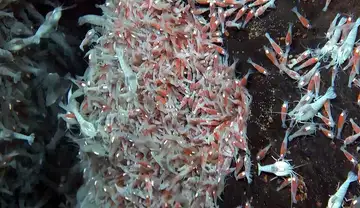
Rimicaris exoculata is a shrimp about 6 cm long that gathers by the tens of thousands on black smoker chimneys along the Mid-Atlantic Ridge. It has light-sensing organs on its back instead of eyes and feeds on bacteria it farms on its body.
See it on the 3D globe →At a glance
- Class
- Crustaceans
- Lives in
- Mid-Atlantic Ridge vents (about 3,500 m deep)
- Length
- about 0.05 m
- Habitat
- deep sea
Quick answers
Where does the Hydrothermal vent shrimp live?
It lives in deep sea of the Atlantic Ocean. On the globe you can find it near Mid-Atlantic Ridge vents (about 3,500 m deep).
How big is the Hydrothermal vent shrimp?
It grows to about 0.05 m.
Rimicaris exoculata is a deep-sea shrimp known as the blind shrimp. It is only 4 to 6 centimetres long and weighs around 1.6 grams, yet it lives in huge crowds, often thousands together, around hot-water chimneys called hydrothermal vents on the Mid-Atlantic Ridge. It has been found at depths down to about 3,600 metres.
The shrimp does not have normal eyes. Instead, it has a large light-sensing patch on its back, beneath a clear part of the shell, which probably helps it sense the faint glow of the hot vents. Its genus name combines Latin and Greek words that mean rift shrimp, after the ridge where it lives. The family it belongs to was named after the research submarine Alvin.
Farming bacteria
Hot water from the vents carries minerals, but sunlight never reaches this deep. The shrimp solves the food problem by farming bacteria. Its gill chamber is enlarged and its mouthparts are covered with thick layers of bacteria that make food from chemicals in the vent water. The bacteria give the shrimp most of its nutrition. The shrimp's gut contains sulphides and iron-oxide particles from the vent fluid.
New shrimp, new bacteria
Young shrimp are not born with their bacteria. Each new generation picks up its partners from the environment when it settles on a vent. The animals cluster where the hot fluid escapes, where the temperature and chemicals change sharply over a short distance. A closely related species, Rimicaris kairei, lives at similar vents in the Indian Ocean. During moulting, the shrimp turns from white to see-through.
Fun facts
- It has no normal eyes, but a light-sensitive patch on its back may sense the faint glow of hot vents.
- It has no normal eyes but a light-sensitive patch on its back.
- Thousands of these shrimp can crowd around a single vent.
- The family name Alvinocarididae honours Alvin, the deep-sea submarine that collected the first samples.
On the globe
The globe places the shrimp on the hot-water vents of the Mid-Atlantic Ridge, about 3,500 metres deep. Look for the dense crowd of small shrimp on the chimneys.
Quiz time
Which is longer: Hydrothermal vent shrimp or American lobster?
Show the answer
American lobster. (0.05 m vs 0.23 m) American lobster →
More like this
.jpg)
Sources
Updated: 2026-10-14