
Sockeye salmon
태평양 연어 떼
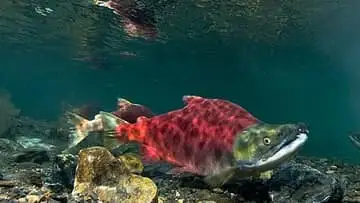
Sockeye salmon are born in rivers, grow up at sea, then swim hundreds or even thousands of km back to their birth stream to spawn. Their bodies turn bright red, they find home by smell, and they die after laying eggs.
See it on the 3D globe →At a glance
- Class
- Fish
- Diet
- Meat eater (carnivore)
- Weight
- about 4.5 kg
- Length
- about 0.7 m
- Lifespan
- up to about 8 years
- Conservation status
- Least Concern (IUCN LC)
- Habitat
- rivers & lakes, open ocean
Quick answers
Where does the Sockeye salmon live?
It lives in rivers & lakes, open ocean of the Pacific Ocean.
How big is the Sockeye salmon?
It grows to about 0.7 m and 4.5 kg.
What does the Sockeye salmon eat?
Its diet: meat eater (carnivore).
How long does the Sockeye salmon live?
It can live up to about 8 years.
Is the Sockeye salmon endangered?
It is listed as Least Concern (IUCN LC).
The sockeye salmon is a Pacific salmon famous for the long journey of its life. It is born in fresh water, swims to the ocean to grow, and then returns to the river where it was born to lay eggs. At sea it is blue with silver, but when it returns to spawn, its body turns bright red and its head turns green.
Sockeye are 60 to 84 centimetres long and weigh 2.3 to 7 kilograms. They live in the North Pacific and rivers flowing into it, from the Columbia River and northern Japan up to the Arctic. Young fish may migrate as far as 1,600 kilometres to reach the ocean, and they feed mostly on tiny floating animals. The IUCN lists the species as Least Concern.
Finding the way home
Adult sockeye find their way back to the stream where they hatched largely by smell. Some travel a very long way, for instance to Redfish Lake in Idaho, more than 1,400 kilometres up river and 2,000 metres above sea level. After laying eggs, sockeye die, which is called semelparous life. Their bodies feed the stream and the animals around it.
Sea-going and landlocked
Not all sockeye go to sea. Some populations, called kokanee, stay in fresh water all their lives. They are smaller, rarely more than 35 centimetres. The name sockeye comes from a Halkomelem word, suk-kegh, which means red fish, from the Indigenous people of the lower Fraser River. In the United States, some sockeye populations have disappeared from parts of Idaho and Oregon.
Fun facts
- Sockeye salmon find their way back to the stream where they hatched largely by smell.
- Sockeye turn bright red and their heads turn green when they return to spawn.
- The farthest-travelling sockeye climb more than 1,400 kilometres up a river to Redfish Lake in Idaho.
- The name sockeye comes from a Halkomelem word meaning red fish.
On the globe
The globe shows the sockeye salmon in the North Pacific, swimming from sea to river. Look for the bright red body.
Quiz time
Which is heavier: Sockeye salmon or Blue marlin?
Show the answer
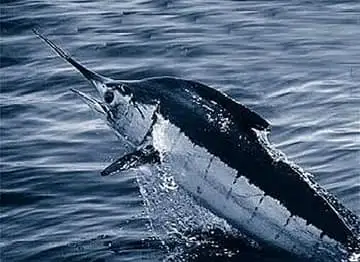
Blue marlin. (4.5 kg vs 140 kg) Blue marlin →
More like this

Sources
Updated: 2026-10-14