
Giant manta ray
대왕쥐가오리
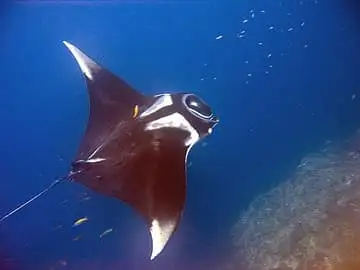
The largest ray, with a wingspan up to 7 m, gliding through the water as if flying. Horn-like fins beside its mouth funnel plankton in. It has one of the biggest brains of any fish and is thought to be quite clever.
See it on the 3D globe →At a glance
- Class
- Fish
- Lives in
- Central Pacific Ocean
- Diet
- Filter feeder
- Lifespan
- up to about 45 years
- Conservation status
- Endangered (IUCN EN)
- Habitat
- open ocean, coasts, coral reefs
Quick answers
Where does the Giant manta ray live?
It lives in open ocean, coasts, coral reefs of the Pacific, Atlantic and Indian oceans. On the globe you can find it near Central Pacific Ocean.
What does the Giant manta ray eat?
Its diet: filter feeder.
How long does the Giant manta ray live?
It can live up to about 45 years.
Is the Giant manta ray endangered?
It is listed as Endangered (IUCN EN).
The giant oceanic manta ray, Mobula birostris, is the largest ray in the world. It can reach 7 metres across the wings and weigh around 3,000 kilograms, though a typical one is about 4.5 metres. It lives in tropical, subtropical and some temperate waters all around the globe and spends most of its life far from land. Before 2017 it was placed in the genus Manta, but DNA tests showed it belongs within Mobula.
Its flat body has big triangular pectoral fins that it flaps like wings, and a pair of head fins that can roll up for swimming or flare out to funnel plankton into its wide mouth. It has the largest brain of any fish, up to about 200 grams, and is one of the few animals that might pass the mirror test. The IUCN lists it as Endangered.
Following the plankton
Giant mantas travel with the currents and migrate to places where nutrient-rich water wells up, because that brings lots of zooplankton such as copepods, mysids and shrimp. They are often seen near offshore oceanic islands. When feeding, a manta swims slowly around its prey, herding the plankton into a tight group, then speeds through with its mouth open.
They may travel alone or in groups of up to 50. In deep water they swim steadily in a straight line, and closer to shore they bask or drift. Seabirds and other fish sometimes keep them company.
Body and markings
The skin is smooth, black, dark brown or steely blue above and white below. The pattern of spots on the belly can be used to recognise individual rays. The tail is long and whip-like, with no spine, unlike its relatives the devil rays. Only about 18 rows of tiny teeth sit in the lower jaw.
It looks like the reef manta ray, but is bigger, usually 4 to 5 metres against 3 to 3.5 metres. The two white patches on the top of the head form a T shape in the oceanic manta and a Y shape in the reef manta.
Slow breeders, big risks
Males mature at about 4 metres wide and females at about 5 metres. Several males may follow a female in a train. A single pup, 1.4 metres wide and 9 kilograms, is born after about 12 to 13 months, and a female breeds only every two to three years.
Because they breed so slowly, losses are hard to replace. Mantas are caught in nets, and their gill rakers are sold at up to about 400 US dollars a kilogram for a tonic with no strong evidence that it helps health. Microplastics are another threat.
Fun facts
- Mantas have one of the largest brains for their body size of any fish.
- It has the largest brain of any fish.
- It is one of the few animals that might pass the mirror test.
- A newborn pup is already 1.4 metres wide.
- Before 2017 it was called Manta birostris.
On the globe
The model shows a giant manta ray gliding with its head fins forward in the open ocean.
More like this

Sources
Updated: 2026-10-14