
Blue marlin
청새치
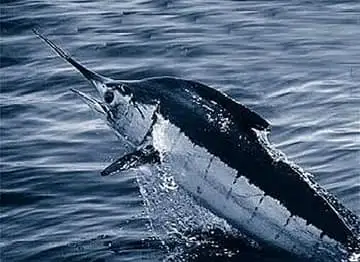
A big open-ocean fish of tropical seas; large females can grow beyond 4 m and 500 kg. It slashes through schools of tuna and squid with its spear-like upper jaw and is one of the fastest swimmers in the sea.
See it on the 3D globe →At a glance
- Class
- Fish
- Diet
- Fish eater
- Weight
- about 140 kg
- Length
- about 3.4 m
- Top speed
- about 72 km/h
- Lifespan
- up to about 27 years
- Conservation status
- Vulnerable (IUCN VU)
- Habitat
- open ocean
Quick answers
Where does the Blue marlin live?
It lives in the open ocean of the Atlantic, Pacific and Indian oceans.
How big is the Blue marlin?
It grows to about 3.4 m and 140 kg.
What does the Blue marlin eat?
Its diet: fish eater.
How fast is the Blue marlin?
It can reach about 72 km/h.
How long does the Blue marlin live?
It can live up to about 27 years.
Is the Blue marlin endangered?
It is listed as Vulnerable (IUCN VU).
The Atlantic blue marlin is a huge fish of the open Atlantic Ocean. It lives in tropical and subtropical waters, far from land, and it is one of the fastest swimmers in the sea. Its upper jaw is drawn out into a long spear called a bill.
Females grow much bigger than males, up to about four times as heavy. The largest published weight is 818 kilograms and the greatest length 5 metres. It is the national fish of the Bahamas and appears on the country's coat of arms. It is closely related to the Indo-Pacific blue marlin, and some experts regard them as one species. The fish is deep blue on its back.
How does it hunt?
A blue marlin preys on many kinds of ocean animals, mostly near the surface. It often uses its bill to stun or injure fish and then comes back to eat them. Top speeds are estimated at up to 72 kilometres per hour, though most of the time it cruises under 4.5 kilometres per hour. Blue marlin live far from land, and spend most of their lives in the open sea. Their speed helps them slash through schools of tuna and squid.
Is it in danger?
Anglers prize it as a game fish, and fishing boats also catch it, either on purpose or by accident in tuna fisheries. Overfishing has made the IUCN consider it a threatened species. The name Makaira comes from the Greek word for a short sword. They breed in summer off Portugal, where heavy fishing has hurt the population. Because the meat is rich in fat, it is valuable in some markets.
Fun facts
- Female blue marlins grow far larger than males, which rarely exceed about 160 kg.
- Females can be about four times heavier than males.
- Its top speed is estimated at 72 kilometres per hour.
- It is the national fish of the Bahamas.
On the globe
The model shows a big blue marlin with a long spear. Look for it in the open Atlantic.
Quiz time
Which is heavier: Blue marlin or Sockeye salmon?
Show the answer
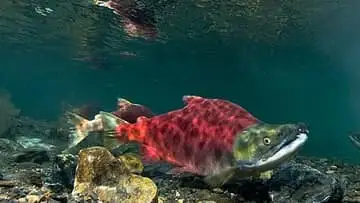
Blue marlin. (140 kg vs 4.5 kg) Sockeye salmon →
More like this

Sources
Updated: 2026-10-14