
Southern ground hornbill
남부땅코뿔새
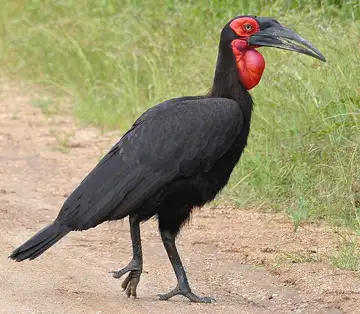
A turkey-sized black bird with a red face and throat wattle and a heavy down-curved bill. It spends most of the day walking in family groups, catching insects, frogs and small snakes.
See it on the 3D globe →At a glance
- Class
- Birds
- Lives in
- Savannas and grasslands of southern Africa, such as Kruger National Park
- Diet
- Meat eater (carnivore)
- Weight
- about 4 kg
- Length
- about 1 m
- Conservation status
- Vulnerable (IUCN VU)
- Habitat
- savannas, grasslands
Quick answers
Where does the Southern ground hornbill live?
It lives in savannas, grasslands. On the globe you can find it near Savannas and grasslands of southern Africa, such as Kruger National Park.
How big is the Southern ground hornbill?
It grows to about 1 m and 4 kg.
What does the Southern ground hornbill eat?
Its diet: meat eater (carnivore).
Is the Southern ground hornbill endangered?
It is listed as Vulnerable (IUCN VU).
The southern ground hornbill is the largest hornbill in the world. It is a turkey-sized black bird, 90 to 129 centimetres long, with bare red skin on the face and throat and a heavy, down-curved bill. It spends most of its day walking on the ground in a family group, rather than flying.
It lives in the savannas and woodlands of southern Africa, from Kenya down to South Africa, including Kruger National Park. It is a carnivore that catches insects, frogs, small snakes and other small animals. The IUCN lists it as Vulnerable. Its nest is often high in a tree hole or in a rock cavity in a cliff.
A very long life and a slow family
Ground hornbills may live 50 to 60 years, and up to 70 in captivity. They grow up slowly: they are not adults until about 4 to 6 years old, and often start to breed at around 10.
You can tell males from females by the throat. In a male it is pure red, and in a female it is deep violet-blue.
A bird in trouble
In Kruger National Park, the ground hornbill is one of the Big Six birds visitors hope to see. It also matters in many local cultures.
Numbers are falling because of persecution, habitat loss and cultural beliefs. It is classed as Endangered in South Africa, Lesotho, Namibia and Eswatini, and as Vulnerable worldwide. Lasting protection needs both wild land and the support of local people.
Fun facts
- Groups give deep booming calls that can be heard kilometres away.
- It is the largest hornbill in the world.
- Groups give deep booming calls that carry for kilometres.
- The colour of its throat shows whether it is male or female.
On the globe
The globe places the southern ground hornbill in the savannas and grasslands of southern Africa, such as Kruger National Park. Look for the red face.
Quiz time
Which is heavier: Southern ground hornbill or Common ostrich?
Show the answer
Common ostrich. (4 kg vs 100 kg) Common ostrich →
More like this
_male_(12714625605),_crop.jpg)
Sources
Updated: 2026-10-14