
Greater vasa parrot
큰바사앵무
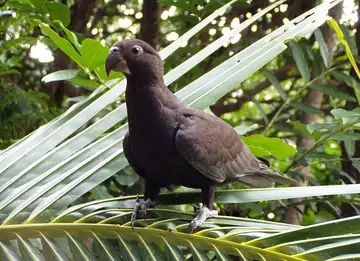
A dark grey-brown parrot of Madagascar with a large pale bill. In the breeding season females can lose head feathers, and the bare skin turns orange, which is unusual among parrots.
See it on the 3D globe →At a glance
- Class
- Birds
- Lives in
- Forests and woodlands of Madagascar
- Diet
- Plant eater (herbivore)
- Length
- about 0.5 m
- Conservation status
- Least Concern (IUCN LC)
- Habitat
- forests
Quick answers
Where does the Greater vasa parrot live?
It lives in forests. On the globe you can find it near Forests and woodlands of Madagascar.
How big is the Greater vasa parrot?
It grows to about 0.5 m.
What does the Greater vasa parrot eat?
Its diet: plant eater (herbivore).
Is the Greater vasa parrot endangered?
It is listed as Least Concern (IUCN LC).
The greater vasa parrot, Coracopsis vasa, is a large, dark grey-brown parrot that lives in Madagascar and the nearby Comoros islands. It does not have the bright colours people expect from parrots. Its big pale bill and noisy flocks are what stand out.
It is one of two vasa parrot species, the other being the lesser vasa parrot. The greater one is more common in the dry deciduous forests, while the lesser prefers the humid forests of the east coast. It was first described by George Shaw in 1812. In many ways it is an odd parrot, with a strange mating system for its group.
What does it eat?
Greater vasa parrots feed in big, noisy flocks on wild berries, fruits, nuts and seeds. They also visit farms for maize, millet and rice. They roost together in the tops of large trees, and a lookout bird warns the others of danger.
They are even active on moonlit nights. The card adds that it feeds in flocks on fruit, nuts and seeds and perches high in tall trees.
What is unusual about their family life?
The breeding season is probably October to December. Females are about a quarter larger than males and are the dominant sex, and each female may mate with several males in a loose group.
During nesting, the female loses the feathers on her head and her bare skin turns bright orange. She sings complex songs from near the nest, which attract males that bring her food. Scientists find its breeding habits so unusual that they study it as a model for how mating systems evolve.
Fun facts
- In the breeding season the female loses the feathers on her head, showing yellow-orange skin.
- A nesting female loses her head feathers and her skin turns orange.
- Females are about 25 percent larger than males.
- Flocks post a lookout to warn of danger, and they are active on moonlit nights.
On the globe
The model shows a dark grey-brown parrot with a large pale bill.
Quiz time
Which is longer: Greater vasa parrot or Southern ground hornbill?
Show the answer
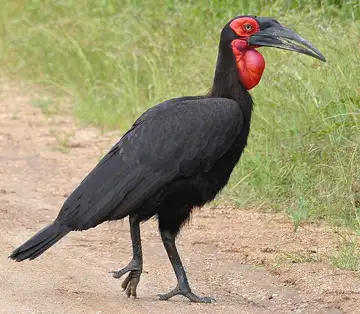
Southern ground hornbill. (0.5 m vs 1 m) Southern ground hornbill →
More like this

Sources
Updated: 2026-10-14