
Striped skunk
줄무늬스컹크
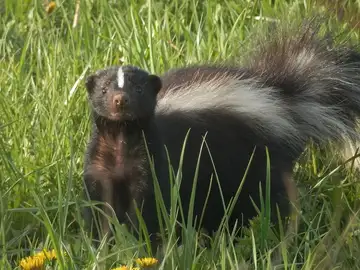
The striped skunk is a North American mammal with a black coat and two white stripes down its back. When threatened it raises its tail and can spray a foul-smelling liquid about 3 metres or more.
See it on the 3D globe →At a glance
- Class
- Mammals
- Lives in
- Prairies and woodland edges of the north-central United States
- Diet
- Eats both plants and meat (omnivore)
- Weight
- about 3 kg
- Length
- about 0.65 m
- Top speed
- about 16 km/h
- Lifespan
- up to about 10 years
- Conservation status
- Least Concern (IUCN LC)
- Habitat
- grasslands, forests, towns & cities
Quick answers
Where does the Striped skunk live?
It lives in grasslands, forests, towns & cities. On the globe you can find it near Prairies and woodland edges of the north-central United States.
How big is the Striped skunk?
It grows to about 0.65 m and 3 kg.
What does the Striped skunk eat?
Its diet: eats both plants and meat (omnivore).
How fast is the Striped skunk?
It can reach about 16 km/h.
How long does the Striped skunk live?
It can live up to about 10 years.
Is the Striped skunk endangered?
It is listed as Least Concern (IUCN LC).
The striped skunk is a cat-sized North American mammal with a black coat and two white stripes down its back that join into a V or Y shape near the neck. Its body is about 30 to 40 centimetres long, with a bushy tail of 22 to 28 centimetres. It lives across southern Canada, the United States and northern Mexico, in prairies, woodland edges and even towns.
The skunk is famous for its defence. When it is threatened it raises its tail and can spray a foul-smelling liquid from glands near its tail. It is mostly active at night and eats almost anything, from insects and small animals to fruit and plants. Because it adapts so well and lives over such a wide range, it is listed as least concern. Males are about a tenth bigger than females, and adults usually weigh 1.8 to 4.5 kilograms.
The smelly warning
Skunks usually give warnings before spraying: they stamp their feet, raise the tail and show off their bold black-and-white colours. The spray can travel about three metres or more and smells terrible, so most animals learn to leave skunks alone. Besides birds of prey, few animals hunt them.
Skunks and people
The English word skunk comes from Algonquian and Iroquoian words. The Cree and Ojibwe word shee-gawk is the root of the name Chicago, which means skunk-land. People have trapped skunks for their fur and kept them as pets, and the animal is a popular character in cartoons and children's books.
Dens and babies
Striped skunks dig their own dens or move into ones that other animals left behind. In farmland they often dig in fencerows, where machines and cattle rarely disturb them. In winter they do not truly hibernate. Their body temperature drops a little, and several females and one male may share a den. Babies, called kits, are born around mid-May to early June, usually five or six at a time. They are blind and almost hairless at birth, open their eyes after about three weeks, and can already take the defensive stance even before their musk has developed. They become independent after about two and a half months.
Fun facts
- It can spray up to about 3 metres.
- It usually stamps its feet and raises its tail as a warning first.
- The city name Chicago comes from a word for skunk-land.
- Its bold stripes act as a warning sign to other animals.
- A skunk kit can raise its tail in warning before its smelly spray is even ready.
On the globe
On the toy globe the striped skunk is placed in the prairies and woodland edges of the north-central United States. Look for the two white stripes.
Quiz time
Which is heavier: Striped skunk or Gray wolf?
Show the answer
Gray wolf. (3 kg vs 40 kg) Gray wolf →
More like this
_02.jpg)
Sources
Updated: 2026-10-14