
Saiga antelope
사이가영양
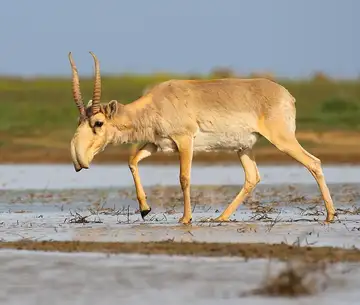
A steppe antelope of Kazakhstan, Russia and Mongolia, famous for its swollen, drooping nose. The nose filters summer dust and warms the freezing winter air. Only males carry the translucent amber horns.
See it on the 3D globe →At a glance
- Class
- Mammals
- Lives in
- Steppes of Kazakhstan, Russia and Mongolia
- Diet
- Plant eater (herbivore)
- Weight
- about 40 kg
- Length
- about 1.2 m
- Top speed
- about 80 km/h
- Conservation status
- Near Threatened (IUCN NT)
- Habitat
- grasslands, deserts
Quick answers
Where does the Saiga antelope live?
It lives in grasslands, deserts. On the globe you can find it near Steppes of Kazakhstan, Russia and Mongolia.
How big is the Saiga antelope?
It grows to about 1.2 m and 40 kg.
What does the Saiga antelope eat?
Its diet: plant eater (herbivore).
How fast is the Saiga antelope?
It can reach about 80 km/h.
Is the Saiga antelope endangered?
It is listed as Near Threatened (IUCN NT).
The saiga is an antelope of the Eurasian steppe, famous for its large, swollen, drooping nose. The nose works like a filter against dust in summer and warms the icy air in winter. Only males have horns, which are translucent amber in colour. The saiga stands about 70 centimetres tall at the shoulder and weighs about 40 kilograms.
Today saigas live in Kalmykia and Astrakhan in Russia, in Kazakhstan, and in western Mongolia. Some of them migrate south in winter, as far as Uzbekistan. They are plant-eaters that travel in big herds across grassland and semi-desert. The saiga has disappeared from places such as Romania, Ukraine, Moldova and China, and the IUCN lists it as Near Threatened.
Ice Age survivor
Long ago the saiga lived over a huge area. During the Ice Age it roamed the mammoth steppe from the British Isles all the way to Beringia, the land that once joined Siberia and Alaska. Its oldest known fossils date to the late Pleistocene, about 100,000 years ago. Scientists now think it is related to the springbok and the gerenuk, which are antelopes from Africa, and not to the Tibetan antelope, which looks similar.
Two kinds
Two subspecies are recognised: the Russian saiga, which lives in Russia and Kazakhstan, and the Mongolian saiga, found only in Mongolia. The first scientific name, Capra tatarica, was given by Carl Linnaeus in 1766, and the animal was later moved to its own genus, Saiga, of which it is the only living member. Saiga have vanished from Romania, Ukraine, Moldova and China, and from south-western Mongolia, so protecting what is left of the steppe habitat matters a great deal.
Fun facts
- Its big, droopy nose filters out dust in summer and warms icy air in winter.
- The saiga's odd nose filters dust and warms cold air.
- Only male saigas grow horns.
- In the Ice Age, saigas roamed from the British Isles to Alaska.
On the globe
The globe places the saiga on the steppes of Kazakhstan, Russia and Mongolia. Look for the swollen nose.
Quiz time
Which is heavier: Saiga antelope or West Caucasian tur?
Show the answer
West Caucasian tur. (40 kg vs 70 kg) West Caucasian tur →
More like this



Sources
Updated: 2026-10-14