
Caspian seal
카스피해물범
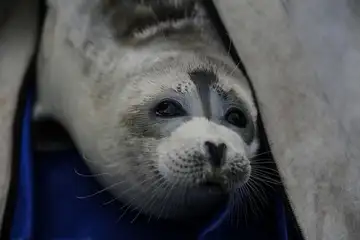
A small seal found only in the Caspian Sea, about 1.3 m long, pale grey with scattered dark spots. In winter it gives birth on the sea ice of the northern Caspian. Numbers have fallen sharply, and it is now endangered.
See it on the 3D globe →At a glance
- Class
- Mammals
- Lives in
- Caspian Sea (Kazakhstan, Russia, Iran)
- Diet
- Fish eater
- Length
- about 1.3 m
- Conservation status
- Endangered (IUCN EN)
- Habitat
- coasts
Quick answers
Where does the Caspian seal live?
It lives in coasts. On the globe you can find it near Caspian Sea (Kazakhstan, Russia, Iran).
How big is the Caspian seal?
It grows to about 1.3 m.
What does the Caspian seal eat?
Its diet: fish eater.
Is the Caspian seal endangered?
It is listed as Endangered (IUCN EN).
The Caspian seal is one of the smallest true seals, and it lives only in the Caspian Sea, the world's largest lake, which is slightly salty. Adults are about 1.3 metres long, pale grey with scattered dark spots. It rests on rocky islands and floating ice.
In winter and cooler spring and autumn months the seals gather in the northern Caspian, where mothers give birth on the sea ice. Since the early 1900s the population has dropped by more than 90 percent, and the species is listed as Endangered. In 2022 a large die-off was reported, so scientists and rangers are watching it closely.
Where does it live and what does it eat?
In summer, when the northern ice melts, the seals move to the deltas of the Volga and Ural rivers and to the cooler, deeper waters in the south. They are mostly fish eaters, taking gobies, sprats, herring, roach and zander, as well as crustaceans such as shrimp. An adult eats about 2 to 3 kilograms of fish a day, nearly a metric ton in a year.
Why is it endangered?
Hunting and changes in the sea, including pollution, have cut the population heavily. Because the Caspian seal is a top predator, harmful chemicals such as heavy metals build up in its body. The seals also depend on winter ice for their pups, which is a problem when the climate warms. Estimates of how many are left are uncertain, from fewer than 70,000 to about 168,000.
Fun facts
- It lives only in the Caspian Sea, the world's largest lake, and its pups are born on the winter ice.
- It lives in only one place, the Caspian Sea.
- Pups are born on the winter ice of the northern Caspian.
- An adult eats about 2 to 3 kilograms of fish every day.
- Its skull suggests it is closely related to the Baikal seal.
On the globe
The model is in the Caspian Sea, between Kazakhstan, Russia and Iran. Zoom in on the northern part to find it.
Quiz time
Which is longer: Caspian seal or Harbour porpoise?
Show the answer
Harbour porpoise. (1.3 m vs 1.6 m) Harbour porpoise →
More like this

Sources
Updated: 2026-10-14