
Giant panda
자이언트판다
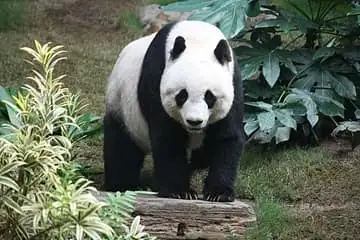
A bear that eats bamboo for over ten hours a day, gripping it with a special 'sixth finger', an enlarged wrist bone. A newborn cub weighs only about 100 g, tiny next to its mother.
See it on the 3D globe →At a glance
- Class
- Mammals
- Lives in
- Mountains of Sichuan, China
- Diet
- Plant eater (herbivore)
- Weight
- about 100 kg
- Length
- about 1.5 m
- Top speed
- about 32 km/h
- Lifespan
- up to about 38 years
- Conservation status
- Vulnerable (IUCN VU)
- Habitat
- forests, mountains
Quick answers
Where does the Giant panda live?
It lives in forests, mountains. On the globe you can find it near Mountains of Sichuan, China.
How big is the Giant panda?
It grows to about 1.5 m and 100 kg.
What does the Giant panda eat?
Its diet: plant eater (herbivore).
How fast is the Giant panda?
It can reach about 32 km/h.
How long does the Giant panda live?
It can live up to about 38 years.
Is the Giant panda endangered?
It is listed as Vulnerable (IUCN VU).
The giant panda is a black-and-white bear that lives only in China, in a few mountain ranges of Sichuan, Shaanxi and Gansu provinces. Adults weigh about 100 to 115 kilograms and are about the size of an American black bear. Pandas live in cool, misty forests between about 1,500 and 3,000 metres high, where thick bamboo grows under the trees.
Even though it belongs to the meat-eating group of mammals, the panda eats almost nothing but bamboo. It has become a symbol of China and of wildlife protection around the world. A national survey published in 2015 counted 1,864 wild pandas older than 18 months, an increase on earlier counts. Thanks to this recovery, the IUCN moved the giant panda from Endangered to Vulnerable in 2016, but it still depends on protected forests to survive.
What does it eat?
Bamboo makes up about 99 percent of a panda's diet. The trouble is that a panda's stomach and gut are built more like a meat-eater's, so it digests bamboo poorly and much of it passes straight through. To get enough energy, a panda eats about 32 to 45 kilograms of bamboo a day and spends 10 to 16 hours feeding. It usually sits upright to eat, like a person sitting on the floor, and crushes the tough stems with big molar teeth and very strong jaws. Between meals it naps for two to four hours at a time.
Amazing body
A panda's front paw has a special 'pseudo-thumb' (false thumb). It is not a real finger but an enlarged wrist bone covered with a fleshy pad, and it helps the panda grip bamboo stems. Scientists are still not sure why pandas are black and white. Some think the pattern helps them hide in shady bamboo and snowy rocks; others think it helps pandas recognise or avoid each other, or keeps their temperature even.
Family life
Pandas mostly live alone and keep in touch by leaving scent marks on trees and rocks. A female can only become pregnant for two or three days each spring. Her newborn cub is pink, blind and toothless and weighs only 90 to 130 grams, about 1/800 of its mother's weight, which makes it the smallest baby compared with its mother of any placental mammal. By its first birthday the cub weighs about 45 kilograms, and it stays with its mother for one and a half to three years.
Fun facts
- A newborn panda cub weighs about as much as a small apple, roughly 1/800 of its mother.
- Pandas can spend up to 16 hours a day eating bamboo.
- The panda's 'sixth finger' is really a stretched-out wrist bone.
- Bamboo makes up about 99 percent of what a giant panda eats.
- Pandas in zoos have lived to about 35 years old, much longer than in the wild.
On the globe
The model shows a giant panda in the mountains of Sichuan, China. Look for its black eye patches and the bamboo it loves.
Quiz time
Which is heavier: Giant panda or Takin?
Show the answer
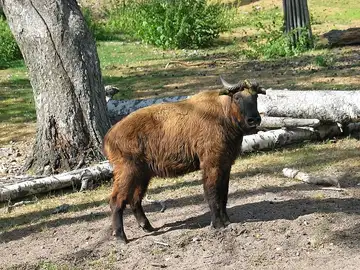
Takin. (100 kg vs 300 kg) Takin →
More like this

Sources
- Read more on Wikipedia
- Giant panda — Wikipedia
- Giant panda — Smithsonian's National Zoo & Conservation Biology Institute
Updated: 2026-10-13