
Zebra shark
지브라상어
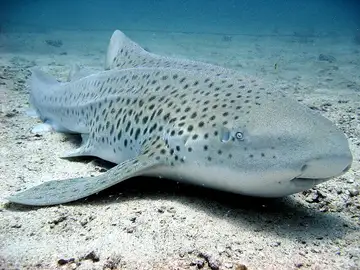
The zebra shark has a long, thick tail and three ridges along its body. Adults are tan with dark spots, while the young are dark with pale stripes like a zebra. It often rests on the seabed of coral reefs during the day.
See it on the 3D globe →At a glance
- Class
- Fish
- Lives in
- Andaman Sea, southern Myanmar
- Diet
- Meat eater (carnivore)
- Conservation status
- Endangered (IUCN EN)
- Habitat
- coral reefs, coasts
Quick answers
Where does the Zebra shark live?
It lives in coral reefs, coasts of the Indian and Pacific oceans. On the globe you can find it near Andaman Sea, southern Myanmar.
What does the Zebra shark eat?
Its diet: meat eater (carnivore).
Is the Zebra shark endangered?
It is listed as Endangered (IUCN EN).
The zebra shark is a slow, gentle shark of warm Indo-Pacific seas. It is a kind of carpet shark, a group that likes to rest on the seabed, and it is the only living member of its family. Adults grow up to about 2.5 metres long. They have five ridges running along a round body and a very long tail that makes up nearly half of their length.
The name sounds odd for a shark covered in dark spots, but it comes from the babies. Young zebra sharks are brown with pale stripes, just like a zebra. As they grow, the stripes break up into spots. These sharks live around coral reefs and sandy flats, and they are harmless to people. Sadly, they are now listed as Endangered.
Where it lives and what it eats
Zebra sharks live across the tropical Indo-Pacific, from the Red Sea and the Indian Ocean to Southeast Asia, Japan and northern Australia. They stay on coral reefs and sandy bottoms, usually no deeper than about 62 metres.
They are nocturnal. By day they lie almost motionless on the sea floor. At night they wake up and slip into holes and cracks in the reef to hunt snails and clams, crabs and shrimps, small fish, and maybe sea snakes.
Babies and danger
Zebra sharks lay eggs. A female produces several dozen big egg capsules and fixes them to underwater objects with sticky threads, so they do not drift away. Young sharks hatch with their striped coats.
Fishing is the main danger. In most places, people catch them for meat, fins and liver oil, and the numbers appear to be shrinking. Because they are calm and hardy, they are also popular in aquariums and with scuba divers.
Fun facts
- Young zebra sharks are striped like a zebra, but adults are covered in spots.
- Baby zebra sharks have stripes, but adults are covered in spots, so grown-up ones are sometimes called leopard sharks.
- The tail of a zebra shark can be almost half of its whole body length.
- The scientific genus name means roughly 'covered mouth' in Greek.
- A zebra shark can rest on the seabed without swimming, which is unusual for a shark.
On the globe
The model shows a tan shark with dark spots and the long, thick tail, resting low near the sea floor where the card places it, in the Andaman Sea.
More like this

Sources
Updated: 2026-10-14