
Blacktip reef shark
블랙팁리프상어
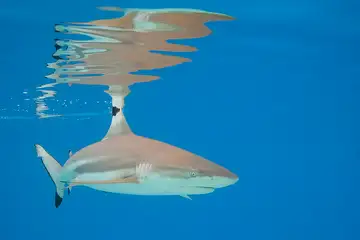
The blacktip reef shark is a medium-sized shark with black-tipped fins, commonly seen in the shallows around coral reefs. About 1.6 m long, it feeds on fish and squid and is rarely dangerous to people.
See it on the 3D globe →At a glance
- Class
- Fish
- Lives in
- Atolls of the Maldives
- Diet
- Fish eater
- Length
- about 1.6 m
- Conservation status
- Vulnerable (IUCN VU)
- Habitat
- coral reefs, coasts
Quick answers
Where does the Blacktip reef shark live?
It lives in coral reefs, coasts of the Indian and Pacific oceans. On the globe you can find it near Atolls of the Maldives.
How big is the Blacktip reef shark?
It grows to about 1.6 m.
What does the Blacktip reef shark eat?
Its diet: fish eater.
Is the Blacktip reef shark endangered?
It is listed as Vulnerable (IUCN VU).
The blacktip reef shark is easy to spot because of the black tips on its fins, especially the first back fin and the tail. It is one of the most common sharks of tropical coral reefs in the Indian and Pacific Oceans. It likes shallow water near the shore, and often cruises over reef ledges and sandy flats.
It grows to about 1.6 metres long, and females are larger than males. Shy and skittish, it is hard to approach and rarely a danger to people. Like other requiem sharks, it belongs to the family Carcharhinidae. It even sometimes enters brackish or fresh water.
What does it eat?
This shark hunts small bony fish, squid and octopuses and crustaceans. It has also been known to eat sea snakes and seabirds. Its home range is very small: a single shark can stay in the same local area for years. It uses its good senses to chase small fish through the shallows. Because it stays in the same area for so long, it can be studied in detail by scientists.
Shark pups and safety
Blacktips are viviparous, which means mothers give birth to live pups, usually two to five at a time. Newborns stay in very shallow water, often roaming in big groups over flats that fill at high tide. People wading through the shallows can sometimes be bitten on the legs by mistake. The IUCN lists the species as Vulnerable. Newborns in the shallows are safe from bigger sharks. Mating begins with the male following closely behind the female, probably attracted by her chemical signals. This shark is used for meat, fins and liver oil, though not a major catch.
Fun facts
- It often swims in water so shallow that its black-tipped dorsal fin sticks out above the surface.
- Its dorsal fin often sticks out above the surface in very shallow water.
- One shark may stay in the same small area for several years.
- Mothers give birth to two to five pups at a time.
On the globe
The model shows a slim grey shark with black fin tips. Look for it over coral reefs.
Quiz time
Which is longer: Blacktip reef shark or Whale shark?
Show the answer
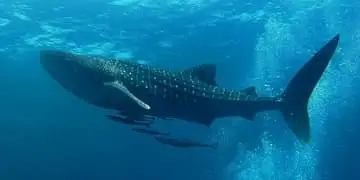
Whale shark. (1.6 m vs 10 m) Whale shark →
More like this
_Moorea.jpg)
Sources
Updated: 2026-10-14