
Banggai cardinalfish
방가이카디널피시
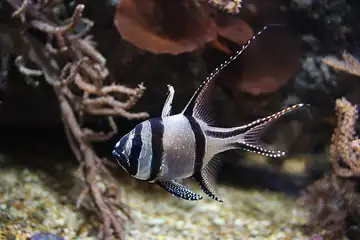
A small fish found only around the Banggai Islands of Indonesia, silver with three black bars and long trailing fins. It reaches about 8 cm, and the male carries the eggs in his mouth until they hatch. It is popular in aquariums and is endangered.
See it on the 3D globe →At a glance
- Class
- Fish
- Lives in
- Banggai Islands, Sulawesi, Indonesia
- Diet
- Meat eater (carnivore)
- Length
- about 0.08 m
- Conservation status
- Endangered (IUCN EN)
- Habitat
- coral reefs, coasts
Quick answers
Where does the Banggai cardinalfish live?
It lives in coral reefs, coasts of the Pacific Ocean. On the globe you can find it near Banggai Islands, Sulawesi, Indonesia.
How big is the Banggai cardinalfish?
It grows to about 0.08 m.
What does the Banggai cardinalfish eat?
Its diet: meat eater (carnivore).
Is the Banggai cardinalfish endangered?
It is listed as Endangered (IUCN EN).
The Banggai cardinalfish is a small tropical fish found only in the Banggai Islands of Indonesia. It grows up to about 8 centimetres long and is easy to recognise: it has three black bars across the head and body, a tasselled first dorsal fin, long trailing fin rays and a deeply forked tail.
Its range is tiny, about 5,500 square kilometres, and the total population is estimated at 2.4 million. It is popular in the aquarium trade, and although it has been bred in captivity, large numbers are still caught in the wild. It is now an endangered species. The most famous thing about it is how it raises its young: the father carries the eggs, and then the babies, in his mouth.
Home among the spines
The fish lives in calm, shallow water, most often at 1.5 to 2.5 metres deep, over coral reefs, seagrass beds and sandy or rubbly areas. Groups of about nine are common, and some groups hold up to 500. They hover close to long-spined sea urchins and slip between the spines when threatened without being stung. Other shelters include sea anemones, branching corals and mangrove roots. Each fish has strong homing habits and returns to its group's spot after being disturbed.
A father's mouth
The Banggai cardinalfish is a paternal mouthbrooder. The female takes an active part in courting, and pairs form a few hours to a few days before spawning. The eggs are about 2.5 millimetres across. The father keeps the young in his mouth after they hatch. Unlike many marine fish, the young have no drifting plankton stage, so they start life as tiny copies of the adults. In the wild the species may live only 1 to 2 years, and up to about 4 years in good captive conditions.
Why is it in danger?
Banggai cardinalfish hardly move between groups, so they cannot spread over large areas, and they have few young. Collecting them for aquariums, harm to their habitat and fatal diseases all hurt their numbers. In 2000 aquarium traders also brought some to the Lembeh Strait, about 400 km north of the natural range. Where collectors remove the fish, the small animals that live with them become less common too.
Fun facts
- The father carries the eggs and babies in his mouth until they are ready to swim.
- The father carries the eggs and babies in his mouth.
- It is the only cardinalfish known to be active in the daytime.
- It can hide among sea urchin spines without being stung.
- Its natural home is only about 5,500 square kilometres.
On the globe
The model shows a small striped fish with long, trailing fins, as in the card. Look at the three dark bars and the tasselled fins.
Quiz time
Which is longer: Banggai cardinalfish or Blue tang?
Show the answer
Blue tang. (0.08 m vs 0.3 m) Blue tang →
More like this

Sources
Updated: 2026-10-14