
Benin: landmarks, animals & facts for kids
1 landmark
Benin on My Earth Toy, the free 3D toy globe for kids: 1 landmark. Here you can see its flag, capital and size, then fly to every place on the globe.
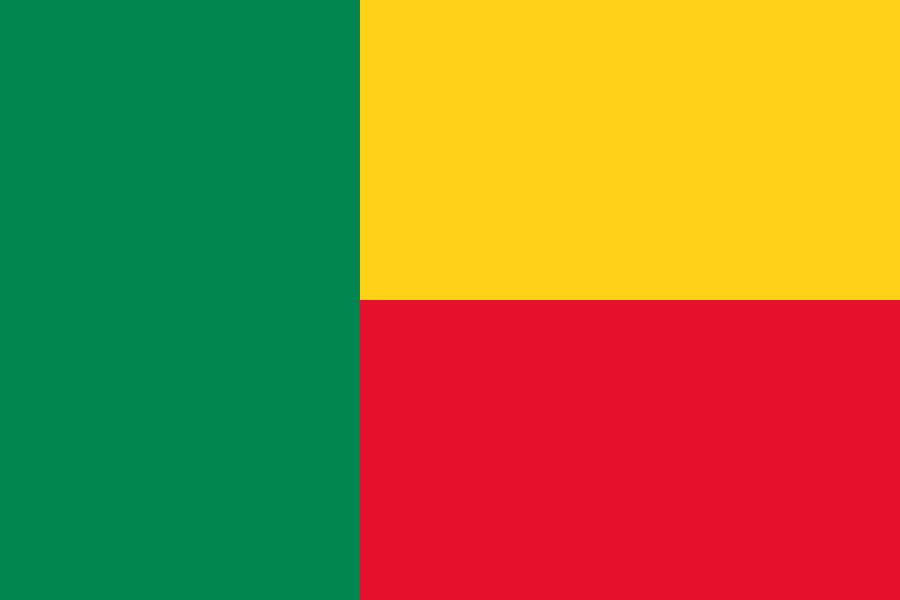
The flag of Benin has a green vertical stripe by the pole and two horizontal stripes, yellow above red, on the rest of the flag.
Read about this flag →Benin at a glance
- Capital
- Porto-Novo
- Continent
- Africa
- Area
- 114,763 km²
- Population
- 14.5 million
Benin is a country in West Africa, a long, narrow strip of land that stretches from the Gulf of Guinea northward to the Niger River. Its official capital is Porto-Novo, while the largest city and seat of government is Cotonou. About 14 million people live there. Benin is known as the home of the old Kingdom of Dahomey, as the birthplace of the Vodun religion, and for its villages built on stilts over a lake.
On My Earth Toy you can see the Door of No Return in Ouidah, a memorial arch on the beach. It remembers the many Africans who were forced onto ships from this coast during the Atlantic slave trade.
Geography and nature
Benin has a short sandy coastline with lagoons and lakes behind it. Inland the land rises gently to plateaus covered with farms, savanna and patches of forest, and in the northwest are the Atakora Mountains. In the north, Pendjari National Park, part of a larger protected area shared with Niger and Burkina Faso, is one of the last strongholds of lions in West Africa and also has elephants, hippos and antelopes.
People, languages and culture
French is the official language, and dozens of local languages are spoken, including Fon and Yoruba. Benin has many religions: Christianity, Islam and Vodun, a traditional faith that honours spirits and ancestors; National Vodun Day is celebrated each January. On Lake Nokoué, the village of Ganvié has thousands of people living in houses on stilts, travelling by canoe to school and the market. Fabric appliqué banners from Abomey tell stories of the old kings.
History in a nutshell
The Kingdom of Dahomey rose in the 1600s with its capital at Abomey, where the royal palaces are now a UNESCO World Heritage Site. Dahomey had a famous regiment of women soldiers. The kingdom took part in the Atlantic slave trade, and the coast became known as the Slave Coast. France conquered Dahomey in the 1890s. The country became independent on 1 August 1960 and changed its name to Benin in 1975.
Fun facts
- Ganvié is often called the 'Venice of Africa' because its streets are water.
- The name Benin comes from the Bight of Benin, the bay on its coast, not from the old Kingdom of Benin, which was in today's Nigeria.
- The palace walls at Abomey are decorated with clay pictures that tell the history of the kings.
- Vodun, the faith that inspired Haitian Vodou, has its roots in this region.
Famous landmarks in Benin
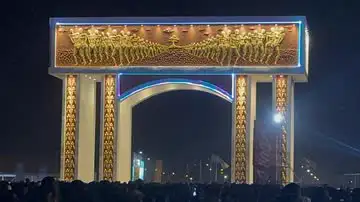
Door of No Return
Benin · Africa
A memorial arch on the beach at Ouidah honouring the Africans taken away in the Atlantic slave trade.
Questions
What is the capital of Benin?
The capital of Benin is Porto-Novo.
Which continent is Benin in?
Benin is in Africa.
How big is Benin?
Benin covers about 114,763 km².
How many people live in Benin?
About 14.5 million people live in Benin.
What are the most famous landmarks in Benin?
On My Earth Toy's free 3D globe, the landmark from Benin is Door of No Return, with a photo and quick facts.
Sources
Updated: 2026-10-30