
Mali: landmarks, animals & facts for kids
2 landmarks · 1 animal
Mali on My Earth Toy, the free 3D toy globe for kids: 2 landmarks, 1 animal. Here you can see its flag, capital and size, then fly to every place on the globe.
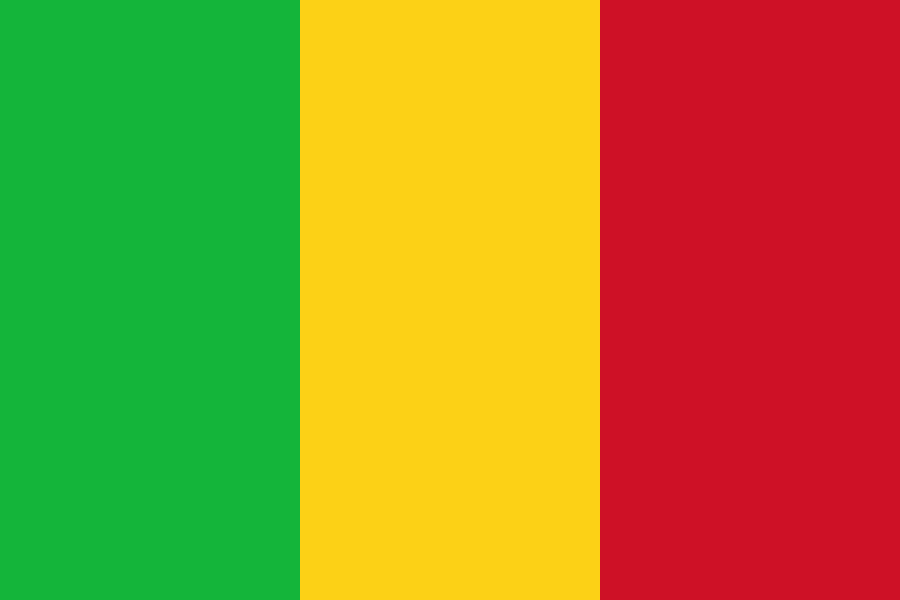
Three equal vertical stripes of green, gold and red, with green next to the flagpole.
Read about this flag →Mali at a glance
- Capital
- Bamako
- Continent
- Africa
- Area
- 1,240,192 km²
- Population
- 24.5 million
Mali is a large landlocked country in West Africa, stretching from the Sahara in the north to green farmland in the south. Its capital, Bamako, lies on the Niger River, the lifeline of the country. Mali was the heart of the medieval Mali Empire, one of the richest empires in history, and it is famous for the old desert city of Timbuktu, its earthen mosques and its music.
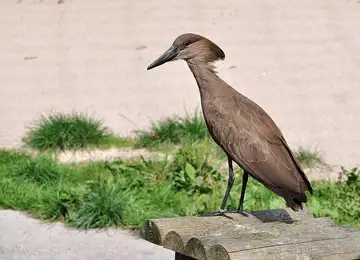
On My Earth Toy you can visit the Great Mosque of Djenné, the largest mud-brick building in the world, and the Sankore Mosque in Timbuktu, once a great centre of learning. Look for the hamerkop, a brown wading bird with a hammer-shaped head that builds enormous nests.
Geography and nature
Mali has three natural zones: the dry Sahara in the north, the semi-arid Sahel in the middle and wetter savanna in the south. The Niger River curves through the country, and each year its floods spread into a huge inland delta of channels, lakes and wetlands where millions of birds spend the winter. In the east, the Bandiagara cliffs rise above the plain, and Hombori Tondo is the highest point at 1,155 metres. Rare desert elephants still roam the Gourma region.
People, languages and culture
Mali has many peoples and languages. Bambara is the most widely spoken, alongside Fula, Soninke, Songhai, Dogon, Tamasheq and French. Most Malians are Muslim. Music is everywhere: griots sing family histories, and instruments such as the kora harp, the ngoni lute and the balafon are played across the country. Each year, the people of Djenné gather to replaster their great mosque with fresh mud. The Dogon people are known for their cliffside villages and carved masks.
History in a nutshell
Mali was part of the Ghana Empire before Sundiata Keita founded the Mali Empire in the 13th century. Its ruler Mansa Musa became famous after a pilgrimage to Mecca in 1324, when he gave away so much gold that its price fell in Cairo. Timbuktu grew into a centre of trade and Islamic scholarship, and later the Songhai Empire ruled the region. France colonised the area as French Sudan in the late 19th century. Mali became independent on 22 September 1960.
Fun facts
- Mansa Musa of Mali is often described as one of the richest people who ever lived.
- The Great Mosque of Djenné is rebuilt with a fresh layer of mud every year in a town-wide festival.
- Hundreds of thousands of old handwritten manuscripts on science, law and religion have been kept in Timbuktu's family libraries.
- A hamerkop's nest can be more than a metre across and strong enough to hold a person's weight.
Famous landmarks in Mali
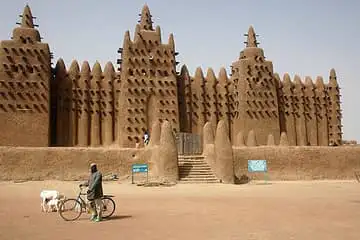
Great Mosque of Djenné
Mali · Africa
The world's largest mud-brick building, re-plastered each year by the townspeople in a communal festival.
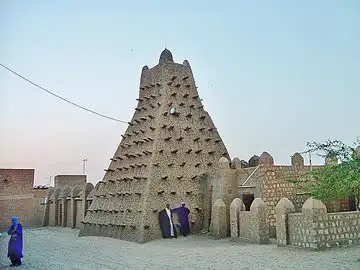
Sankore Mosque
Mali · Africa
Timbuktu's mud-brick mosque and medieval seat of learning, with a tapering minaret bristling with wooden beams.
Animals in Mali
Questions
What is the capital of Mali?
The capital of Mali is Bamako.
Which continent is Mali in?
Mali is in Africa.
How big is Mali?
Mali covers about 1,240,192 km².
How many people live in Mali?
About 24.5 million people live in Mali.
What are the most famous landmarks in Mali?
Some of the best-known landmarks in Mali are Great Mosque of Djenné and Sankore Mosque. My Earth Toy has 2 landmarks from Mali on its free 3D globe, each with a photo and quick facts.
Which animals can you find in Mali on My Earth Toy?
On the globe you can find Hamerkop in Mali.
Sources
Updated: 2026-10-30