
Great Mosque of Djenné
젠네 대모스크
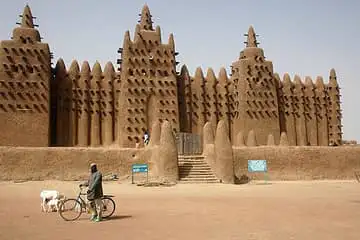
The Great Mosque of Djenné is a huge mosque in the town of Djenné in Mali, West Africa. It stands on the flood plain of the Bani River and is the largest building in the world made of adobe, which means bricks of earth dried in the sun. Its walls are smooth and rounded, with tall box-shaped towers topped by cone-shaped spires and rows of wooden sticks poking out.
See it on the 3D globe →At a glance
- Country
- Mali
- Location
- Djenné, Mali
- Built
- 1907
- Height
- 16 m
- Type
- Religious building
Quick answers
Where is Great Mosque of Djenné?
Great Mosque of Djenné is in Djenné, Mali.
When was Great Mosque of Djenné built?
Great Mosque of Djenné was built in 1907.
How tall is Great Mosque of Djenné?
Great Mosque of Djenné is about 16 m tall.
The world's largest mud-brick building, re-plastered each year by the townspeople in a communal festival.
A mosque has stood on this spot since about the 13th century, but the building you see today was finished in 1907. It is the heart of the town's community and one of the most famous landmarks in Africa. In 1988 UNESCO listed it as a World Heritage Site together with the old town of Djenné, where almost every building is made of mud too.
History
Old writings say that a ruler of Djenné called Koi Kunboro became a Muslim and turned his palace into the first mosque, sometime between about 1200 and 1330. Later rulers added towers and walls, and in the Middle Ages Djenné became an important centre of Islamic learning where thousands of students studied the Quran. In the 1800s a new ruler let the old mosque fall into ruin and built a plainer one nearby. In 1906, while Mali was under French colonial rule, the town arranged for the great mosque to be rebuilt on its original site. The work was directed by Ismaila Traoré, head of Djenné's guild of masons.
How it was built
The walls are made of sun-dried earth bricks called ferey, held together with mud mortar and covered with a smooth mud plaster. The whole building sits on a raised platform about 75 metres on each side and 3 metres high, which keeps it safe when the river floods. The front wall faces east towards Mecca and has three large towers; the middle one is about 16 metres tall. Bundles of palm sticks called toron stick out of the walls. They decorate the building and also work as a ready-made ladder for repairs. Thick mud walls keep the prayer hall cool even when it is 45 °C outside.
The yearly mud festival
Rain and heat crack the mud plaster every year, so the whole town repairs the mosque together in a festival called the Crépissage, French for "plastering", usually held in April before the rainy season. Mud from the river is mixed with rice husks and left for weeks to mature, and boys help stir it by playing in it. On the big day there is a race to bring the first load of mud. Men climb the toron and spread fresh mud by hand while women and girls carry water. Members of the masons' guild direct the work, and elders watch from seats of honour. There is music and food, too.
Fun facts
- Each year the townspeople re-coat it with fresh mud in a festival called the Crépissage.
- The Great Mosque of Djenné is the largest mud-brick building in the world.
- The sticks poking out of the walls double as built-in scaffolding for climbing during repairs.
- Boys help prepare the mud plaster by playing and splashing in the mixing pits.
- The festival starts with a race to see who can deliver the first load of mud to the mosque.
- In 1930 a copy of the mosque was built in Fréjus, in the south of France.
On the globe
The model shows the world's largest mud-brick building in Djenné, Mali, with its rounded earthen walls and towers. Look for the rows of wooden sticks poking out of the walls that townspeople climb when they re-plaster it each year.
Quiz time
Which is taller: Great Mosque of Djenné or Basilica of Our Lady of Peace of Yamoussoukro?
Show the answer
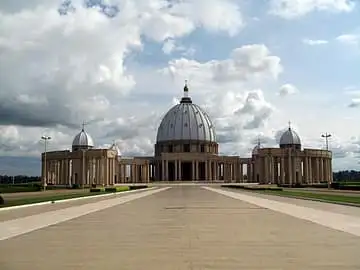
Basilica of Our Lady of Peace of Yamoussoukro. (16 m vs 158 m) Basilica of Our Lady of Peace of Yamoussoukro →
Nearby on the globe

Sources
- Read more on Wikipedia
- Great Mosque of Djenné — Wikipedia
- 젠네 모스크 — 위키백과
- Why Does the Great Mosque of Djenne Need to be Repaired Every Year? — Google Arts & Culture (Instruments for Africa)
Updated: 2026-10-13