
Sankore Mosque
상코레 모스크
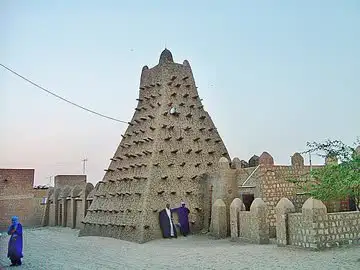
The Sankore Madrasa, also called the Sankore Mosque, is one of three old mosques in the city of Timbuktu in Mali, in West Africa. The others are Djinguereber and Sidi Yahya. It was founded in the 14th or early 15th century with money from a Tuareg woman of the Aghlal tribe, and it was a place where people prayed and also where scholars taught.
See it on the 3D globe →At a glance
- Country
- Mali
- Location
- Timbuktu, Mali
- Built
- c. 1300s
- Type
- Religious building
Quick answers
Where is Sankore Mosque?
Sankore Mosque is in Timbuktu, Mali.
Timbuktu's mud-brick mosque and medieval seat of learning, with a tapering minaret bristling with wooden beams.
The building is made of mud-brick, and its tapering minaret is dotted with wooden beams that stick out of the walls. Its Sudano-Sahelian style looks different from mosques in North Africa and Andalusia. Over the years, rulers of the Mali Empire and later the Songhai Empire helped to support and repair it. After the Battle of Tondibi in 1591, the city declined.
A centre of learning
People sometimes call it the University of Sankore. However, there is no evidence that it was one big central school. Instead, it was a place where individual scholars, called sheikhs or ulama, each taught their own students, often for as long as ten years, and some lectures and classes were also held there. There were no student registers or set courses. Classes met at the mosque or at the teacher's home. In this way it helped make Timbuktu famous for study and books.
A golden age of books
Timbuktu grew as a trading centre in the 14th century. Scholars from as far as Egypt, Libya, Algeria and Morocco settled there and gathered books from all over the Muslim world. The golden age came in the 16th century under Askia Muhammad of the Songhai Empire. In 1526 the traveller Leo Africanus wrote that books brought there sold for more money than any other goods. Some Sankore scholars owned private libraries of more than 1,600 manuscripts. In 1591 Morocco's invasion ended the Songhai Empire, and in 1594 many scholars, including Ahmed Baba, were arrested and sent to Morocco with their books.
Mud-brick, rebuilding and today
The walls are made from mud bricks and plaster. The wooden beams that poke out of the tower are a common feature of Sahel-style buildings, and they also serve as built-in scaffolding for yearly repairs. Between 1578 and 1582 the chief judge Al-Aqib had the sanctuary rebuilt with the dimensions of the Kaaba in Mecca. Today flooding, a lack of repairs and new building threaten the madrasa, and committees work to protect it.
Fun facts
- It was a medieval centre of learning, known as the University of Sankore.
- It is one of three medieval mosques in Timbuktu.
- Its minaret is covered in wooden beams that stick out of the mud walls.
- Sankore scholars taught in the mosque or at their own homes, with no central school.
- Some scholars owned over 1,600 manuscripts.
On the globe
The model shows the mud-brick mosque with its tall tapering minaret and wooden beams. Look for the beams sticking out of the walls.
Nearby on the globe

Sources
- Read more on Wikipedia
- Sankoré Madrasah — Wikipedia (English)
- Sankoré Madrasah — Wikipedia (full article)
Updated: 2026-10-14