
Palau: landmarks, animals & facts for kids
1 landmark
Palau on My Earth Toy, the free 3D toy globe for kids: 1 landmark. Here you can see its flag, capital and size, then fly to every place on the globe.
Palau at a glance
- Capital
- Ngerulmud
- Continent
- Oceania
- Area
- 459 km²
- Population
- 17,727 people
Palau is a small island country in the western Pacific Ocean, in the region called Micronesia, east of the Philippines. It is made up of about 340 islands, but only a handful have people living on them. The capital is Ngerulmud on the biggest island, Babeldaob, while the largest town is Koror. Only around 18,000 people live in the whole country.
Palau is famous for its clear turquoise lagoons, coral reefs and mushroom-shaped Rock Islands, which make it one of the world's best places for diving. On the globe you can find the Airai Bai, a traditional Palauan meeting house with a tall, steep roof and painted storyboards that tell old legends.
Geography and nature
Babeldaob is a large, hilly volcanic island, while many of Palau's other islands are made of old coral limestone. The Rock Islands Southern Lagoon, a UNESCO World Heritage Site, has hundreds of green, rounded islets rising from blue water. Inside one island lies Jellyfish Lake, home to millions of golden jellyfish. Palau's reefs are full of sharks, manta rays, turtles and hundreds of kinds of coral. In 2009 Palau created one of the world's first shark sanctuaries, and later it protected most of its ocean waters from fishing.
People, languages and culture
Palauan and English are the official languages, and on one small island, Angaur, Japanese is official too. Families are organised in clans, and women traditionally hold important roles, including choosing clan chiefs. The bai, a men's meeting house, is a symbol of Palauan culture; its beams are carved and painted with stories. Fish, taro and coconut are traditional foods. Every visitor must sign the Palau Pledge in their passport, a promise to the children of Palau to protect the islands.
History in a nutshell
People reached Palau from Southeast Asia at least 3,000 years ago. Spain claimed the islands in the 1800s and sold them to Germany in 1899. Japan took control in 1914, and during the Second World War, fierce fighting took place on the island of Peleliu in 1944. After the war, the United States looked after Palau as part of a United Nations trust territory. Palau became fully independent in 1994 and keeps a close partnership with the United States.
Fun facts
- The giant stone money of the nearby island of Yap was carved from rock quarried in Palau and carried across the sea by canoe and raft.
- The golden jellyfish in Jellyfish Lake have only a very weak sting, so swimmers have been able to snorkel among them.
- Palau's flag is a yellow full moon on a blue background; the moon is placed slightly off-centre.
- The Palau Pledge stamped into visitors' passports was written with the help of Palau's children.
Famous landmarks in Palau
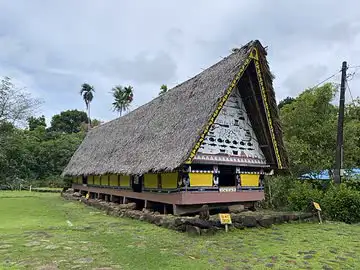
Airai Bai (Palauan meeting house)
Palau · Oceania
A Palauan bai, the traditional men's meeting house: a nail-less timber frame under a tall, steep thatched roof, its gables painted with storyboard legends.
Questions
What is the capital of Palau?
The capital of Palau is Ngerulmud.
Which continent is Palau in?
Palau is in Oceania.
How big is Palau?
Palau covers about 459 km².
How many people live in Palau?
About 17,727 people people live in Palau.
What are the most famous landmarks in Palau?
On My Earth Toy's free 3D globe, the landmark from Palau is Airai Bai (Palauan meeting house), with a photo and quick facts.
Sources
Updated: 2026-10-30